
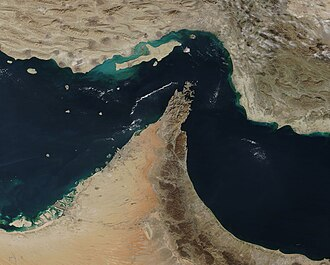
The Straits of Hormuz
The Straits of Hormuz have been the focus of the world’s energy consumers and producers. Its importance lies in the fact that it is the gateway to consuming countries outside the Persian Gulf. Access to the Persian Gulf provides trade opportunities to major energy-producing countries in the area: Bahrain, Iran, Iraq, Kuwait, Qatar, Saudi Arabia, and the United Arab Emirates.
Oil movements through the Straits of Hormuz
The Strait of Hormuz is the primary export route for oil from Saudi Arabia, the UAE, Kuwait, Qatar, Iraq, Bahrain, and Iran. In 2025, about 20 million barrels per day of crude oil and petroleum products passed through the strait. This volume accounted for approximately 25% of all global waterborne oil trade. This amount is equivalent to about 20% of total world oil consumption. Around 80% of the oil moving through the strait is transported to Asian countries. China, India, Japan, and South Korea are the main importers.
Liquefied natural gas (LNG) trade through the Straits of Hormuz
Waterborne shipments of natural gas are transported in the form of a refrigerated liquid. The Straits of Hormuz are the only maritime route for LNG exports from Qatar and the UAE. This volume is equivalent to about 20% of global LNG trade. The straits allow shipments of 93% of Qatar’s and 96% of the UAE’s LNG exports. The major LNG importers are China, India, and South Korea. These three countries accounted for 52% of LNG flows through the Straits of Hormuz in 2024. The impact on world energy is huge, with 25% of global seaborne oil trade, about 20% of global LNG trade, and approximately 20% of global oil consumption moving through the straits.
Questions
The world’s reliance on crude oil and natural gas from the Persian Gulf raises several questions:
- With 80% of the crude oil destined for Asia, why aren’t China, India, Japan, and South Korea doing more to end the war and/or using their military to allow traffic through the straits? Pakistan has offered to moderate peace negotiations.
- With 52% of the LNG shipments being sent to China, India, and South Korea, why aren’t these three countries doing more to end the war and/or using their military to allow traffic through the straits?
United States – NATO Relations
According to a report in The Guardian, “Countries including the UK, Japan, China, and South Korea have said they are still considering their options but without making commitments after the US president, Donald Trump, urged them to send warships to the Straits of Hormuz to secure the vital shipping route.”
The BBC reported that “President Donald Trump has said the US does not need the help of other countries in its war against Iran, just days after calling on US allies to help secure the vital Strait of Hormuz. In a scathing post on his Truth Social platform, he said ‘most’ of America’s Nato allies had informed the US they did not want to get involved. ‘I am not surprised by their action, however, because I always considered NATO… to be a one-way street – We will protect them, but they will do nothing for us,’ he wrote.”
Today, Iran and the United States continue the verbal battle of threats and changing conditions, increasing the possibility of a prolonged conflict and high energy prices.


