The Wounded Knee Massacre, also known as the Battle of Wounded Knee, occurred on December 29, 1890, near Wounded Knee Creek on the Lakota Pine Ridge Indian Reservation in South Dakota. It was the deadliest mass shooting in American history, during which nearly three hundred Lakota people were shot and killed by U.S. Army soldiers. The United States Congress awarded nineteen Medals of Honor to soldiers and officers who perpetrated the slaughter of from 250 to 300 Native Americans.
Other Major Native American Massacres
Selected List of American Indian Murders from 1864 to 1890<1>
Cottonwood Massacre
Year: 1864
Date:
State: California
Description: White settlers from the town of Cottonwood, California, killed twenty male and female Yanas.
Killed: 20
Massacre at Bloody Tanks
Year: 1864
Date:
State: Arizona
Description: A group of white settlers killed nineteen Apaches at a “peace parley”.
Killed: 19
Oak Run Massacre
Year: 1864
Date:
State: California
Description: California settlers massacred three hundred Yana Indians who had gathered near the head of Oak Run, California, for a spiritual ceremony.
Killed: 300
Skull Valley Massacre
Year: 1864
Date:
State: Arizona
Description: A group of Yavapai families was lured into a trap and massacred by U.S. soldiers in Arizona. The place was named Skull Valley after the heads of the dead Indians that were left unburied.
Killed: Unknown
Sand Creek Massacre
Year: 1864
Date: November 29
State: Colorado
Description: Members of the Colorado Militia, in retaliation for theft and violence by Cheyenne Indians against settlers, attacked a village of Cheyenne, killing up to six hundred men, women, and children at Sand Creek in Kiowa County.
Killed: 70-600
Mud Lake Massacre
Year: 1865
Date: March 14
State: Nevada
Description: U.S. troops attacked a Paiute camp near Winnemucca Lake and killed thirty-two Native Americans.
Killed: 32
The Squaw Fight – The Grass Valley Massacre
Year: 1865
Date: July 18
State: Utah
Description: While searching for Antonga Black Hawk, the Mormon militia came upon a band of Ute Indians. Thinking they were part of Black Hawk’s band, they attacked them. They killed ten men and took the women and children captive. After the women and children tried to escape, the militia shot them too.
Killed: 10 men and an unknown number of women and children
Owens Lake Massacre
Year: 1865
Date:
State: California
Description: Following the murder of Mrs. McGuire and her son at Haiwai Meadows, White vigilantes tracked the attackers from the meadows to a Paiute camp on Owens Lake in California. They attacked it, killing about forty men, women, and children.
Killed: 40
Thacker Pass Massacre
Year: 1865
Date: September 12
State: Nevada
Description: The First Nevada Cavalry murdered Paiute men, women, and children.
Killed: 31+
Aquarius Mountains
Year: 1867
Date:
State: Arizona
Description: Yavapai County Rangers killed Native American men, women, and children in the southern Aquarius Mountains, Arizona.
Killed: 23
Campo Seco
Year: 1868
Date:
State: California
Description: A posse of white settlers massacred thirty-three Yahis in a cave north of Mill Creek, California.
Killed: 33
Massacre at La Paz
Year: 1868
Date: September 24
State: Arizona
Description: A group of teamsters attacked a sleeping Yavapai camp on the outskirts of La Paz, Arizona.
Killed: 15
Washita Massacre (Battle of Washita River)
Year: 1868
Date: November 27
State: Oklahoma
Description: Lt. Col. G. A. Custer’s Seventh U.S. Cavalry attacked a village of sleeping Cheyenne led by Black Kettle. Custer reported 103 – later revised to 140 – warriors, “some” women and “few” children killed, and fifty-three women and children were taken hostage. Other casualty estimates by cavalry members, scouts, and Indians vary widely, with the number of men killed ranging as low as eleven and the numbers of women and children ranging as high as seventy-five and as low as seventeen. Before returning to their base, the cavalry killed several hundred Indian ponies and burned the village.
Killed: 17-75
Marias Massacre
Year: 1870
Date: January 23
State: Montana
Description: US troops killed 173 Piegan, mainly women, children, and the elderly after being led to the wrong camp by a soldier who wanted to protect his Indian wife’s family.
Killed: 173-217
Kingsley Cave Massacre
Year: 1871
Date:
State: California
Description: Four settlers killed thirty Yahi Indians in Tehama County, California, about two miles from Wild Horse Corral in the Ishi Wilderness. This massacre left only fifteen members of the Yahi tribe alive
Killed: 30
Camp Grant Massacre
Year: 1871
Date: April 30
State: California
Description: Led by the ex-Mayor of Tucson, William Oury, eight Americans, 48 Mexicans, and more than 100 allied Pima attacked Apache men, women, and children at Camp Grant, Arizona Territory, killing 144, with 1 survivor at the scene and 29 children sold into slavery. All but eight of the dead were Apache women or children.
Killed: 144
Skelton Cave Massacre
Year: 1872
Date: December 30
State: Arizona
Description: U.S. troops and Indian scouts killed seventy-six Yavapai Native American men, women, and children in a remote cave in Arizona’s Salt River Canyon.
Killed: 30
Sappa Creek Massacre
Year: 1875
Date: April
State: Kansas
Description: Soldiers under Lt Austin Henly trapped a group of 27 Cheyenne (19 men, 8 women, and children) on the Sappa Creek in Kansas and killed them all.
Killed: 27
Battle of the Big Hole
Year: 1877
Date: August 8
State: Montana
Description: US troops under Colonel John Gibbon attacked a Nez Perce encampment on the North fork of the Big Hole River in Montana Territory during the Nez Perce War. They killed 70 to 90, including 33 warriors, before being repulsed by the Indians. 31 US soldiers were killed.
Killed: 70-90
Fort Robinson Massacre
Year: 1879
Date: January 9-21
State: Nebraska
Description: U.S. troops and Indian scouts killed seventy-six Yavapai Native American men, women, and children in a remote cave in Arizona’s Salt River Canyon.
Killed: 64-77
Strong Hold
Year: 1890
Date: December 16
State: South Dakota
Description: South Dakota Home Guard militiamen ambushed and massacred 75 Sioux at the Stronghold, in the northern portion of Pine Ridge Indian Reservation.
Killed: 75
Wounded Knee Massacre
Year: 1890
Date: December 29
State: South Dakota
Description: U.S. troops and Indian scouts killed seventy-six Yavapai Native American men, women, and children in a remote cave in Arizona’s Salt River Canyon.
Killed: 130-250
Based on the selected list of atrocities against Native Americans, from 1,379 to 2,164 men, women, and children were murdered.
Diseases killed many Native Americans. In the pandemic of 1837 to 1840, it devastated the entire continent west of the Mississippi, from Texas to Alaska. It is estimated that between 100,000 and 300,000 Native Americans died from smallpox alone during those three years.<2>
The “Remove the Stain Act”
Recent efforts have been made to rescind these medals. The “Remove the Stain Act” proposed on March 26, 2021, outlines some of the reasons why this bill was introduced in the United States House of Representatives. According to the bill’s sponsors:
(1) The Medal of Honor is the highest military award of the United States.
(2) Congress found that to earn the Medal of Honor “the deed of the person … must be so outstanding that it clearly distinguishes his gallantry beyond the call of duty from lesser forms of bravery”.
(3) The actions of Medal of Honor recipients inspire bravery in those currently serving in the Armed Forces and those who will come to serve in the future.
(4) Those listed on the Medal of Honor Roll have come to exemplify the best traits of members of the Armed Forces, a long and proud lineage of those who went beyond the call of service to the United States of America.
(5) To date the Medal of Honor has been awarded only 3,522 times, including only 145 times for the Korean War, 126 times in World War I, 23 times during the Global War on Terror, and 20 times for the massacre at Wounded Knee.
(6) The Medal of Honor is awarded in the name of Congress.
(7) As found in Senate Concurring Resolution 153 of the 101st Congress, on December 29, 1890, the 7th Cavalry of the United States engaged a tribal community “resulting in the tragic death and injury of approximately 350–375 Indian men, women, and children” led by Lakota Chief Spotted Elk of the Miniconjou band at “Cankpe’ Opi Wakpa” or “Wounded Knee Creek”.
(8) This engagement became known as the “Wounded Knee Massacre”, and took place between unarmed Native Americans and soldiers, heavily armed with standard issue army rifles as well as four “Hotchkiss guns” with five 37 mm barrels capable of firing 43 rounds per minute.
(9) Nearly two-thirds of the Native Americans killed during the Massacre were unarmed women and children who were participating in a ceremony to restore their traditional homelands before the arrival of European settlers.
(10) Poor tactical emplacement of the soldiers meant that most of the casualties suffered by the United States troops were inflicted by friendly fire.
(11) On January 1st, 1891, Major General Nelson A. Miles, Commander of the Division of Missouri, telegraphed Major General John M. Schofield, Commander-in-Chief of the Army notifying him that “[I]t is stated that the disposition of four hundred soldiers and four pieces of artillery was fatally defective and large number of soldiers were killed and wounded by the fire from their own ranks and a very large number of women and children were killed in addition to the Indian men.”
(12) The United States awarded 20 Medals of Honor to soldiers of the U.S. 7th Cavalry following their participation in the Wounded Knee Massacre.
(13) In 2001, the Cheyenne River Sioux Tribe, a member Tribe of the Great Sioux Nation, upon information provided by Lakota elders and by veterans, passed Tribal Council Resolution No. 132–01, requesting that the Federal Government revoke the Medals of Honor from the soldiers of the United States Army, 7th Cavalry issued following the massacre of unarmed men, women, children, and elderly of the Great Sioux Nation on December 29, 1890, on Tribal Lands near Wounded Knee Creek.
(14) The National Congress of American Indians requested in a 2007 Resolution that the Congress “renounce the issuance of said medals, and/or to proclaim that the medals are null and void, given the atrocities committed upon unarmed men, women, children and elderly of the Great Sioux Nation”.
(15) General Miles contemporaneously stated that a “[w]holesale massacre occurred and I have never heard of a more brutal, cold-blooded massacre than that at Wounded Knee.”
(16) Allowing any Medal of Honor, the United States highest and most prestigious military decoration, to recognize a member of the Armed Forces for distinguished service for participating in the massacre of hundreds of unarmed Native Americans is a disservice to the integrity of the United States and its citizens, and impinges on the integrity of the award and those who have earned the Medal since.
The bill was referred to the Referred to the House Committee on Armed Services. But no action has been taken. <3>
The Ghost Dance

The years leading up to the Wounded Knee Massacre were marked by profound injustices and tensions arising from broken promises, land seizures, and the cultural and economic devastation experienced by Native American tribes. The Ghost Dance movement emerged as a spiritual and cultural response to these hardships, but it was tragically misunderstood and violently suppressed by federal authorities, culminating in one of the darkest chapters in Native American history.
The stage was set for the Wounded Knee Massacre by a series of actions by the Native Americans, American settlers, and the U.S. government. The U.S. government, through various policies and actions, continued to encroach upon and seize Native American lands, including those of the Lakota Sioux. This led to significant resentment and unrest among the Native American tribes. Bison, which were a vital resource for many Plains Indian tribes, were hunted to near extinction. This depletion devastated the traditional way of life and economy of these tribes, forcing them into dependency on government rations and exacerbating their hardship. U.S. government treaties that were supposed to protect Native American reservation lands from encroachment by settlers and miners were frequently violated or ignored by the government. This further fueled dissatisfaction and anger among Native American tribes.
These actions helped produce the Ghost Dance Movement. The Ghost Dance religion, introduced by the Paiute prophet Wovoka, spread among various Native American tribes in the late nineteenth century. According to Wovoka, the white invaders would disappear from Native lands, the ancestors would lead them to good hunting grounds, the buffalo herds and all the other animals would return in abundance, and the ghosts of their ancestors would return to Earth—hence the “Ghost Dance”. They would then live in peace. All this would be brought about by the performance of the slow and solemn Ghost Dance, performed as a shuffle in silence to a slow, single drumbeat. Lakota ambassadors to Wovoka, Kicking Bear, and Short Bull, taught the Lakota that while performing the Ghost Dance, they would wear special Ghost Dance shirts, as had been seen by Black Elk in a vision. Kicking Bear misunderstood the meaning of the shirts, and said that the shirts had the power to repel bullets. Some tribes, including the Sioux, believed that a great earthquake and flood would occur which would drown all the whites.
The U.S. government misunderstood and feared the Ghost Dance Movement and the government considered it as a potential threat. Authorities worried that the movement might incite resistance or rebellion among Native Americans who felt disenfranchised and oppressed. This led to increased military presence around reservations.
U.S. settlers were alarmed by the sight of the many Great Basin and Plains Tribes performing the Ghost Dance and worried that it might be a prelude to an armed attack. Among them was the U.S. Indian agent at the Standing Rock Agency where Chief Sitting Bull lived. U.S. officials decided to take some of the chiefs into custody to quell what they called the “Messiah craze”. Standing Rock agent James McLaughlin sent the Indian police to arrest Sitting Bull.
On December 15, 1890, forty Native American policemen arrived at Sitting Bull’s house to arrest him. When Sitting Bull refused to comply, the police used force on him. The Lakota in the village were enraged. Catch-the-Bear, a Lakota, shouldered his rifle and shot Lieutenant Bullhead, who reacted by firing his revolver into the chest of Sitting Bull. Another police officer, Red Tomahawk, shot Sitting Bull in the head, and he dropped to the ground. He died between 12 and 1 p.m.
After Sitting Bull’s death, 200 members of his Hunkpapa band, fearful of reprisals, fled Standing Rock to join Chief Spotted Elk (aka “Big Foot”) and his Miniconjou band at the Cheyenne River Indian Reservation. Spotted Elk and his band, along with thirty-eight Hunkpapa, left the Cheyenne River Reservation on December 23, 1890, to travel to the Pine Ridge Indian Reservation to seek shelter with Red Cloud.
In his opinion, former Pine Ridge Indian agent Valentine T. McGillycuddy was quoted as writing:
As for the ‘Ghost Dance’ too much attention has been paid to it. It was only the symptom or surface indication of a deep-rooted, long-existing difficulty; as well treat the eruption of smallpox as the disease and ignore the constitutional disease.
As regards disarming the Sioux, however desirable it may appear, I consider it neither advisable, nor practicable. I fear it will result as the theoretical enforcement of prohibition in Kansas, Iowa and Dakota; you will succeed in disarming and keeping disarmed the friendly Indians because you can, and you will not succeed with the mob element because you cannot.
If I were again to be an Indian agent, and had my choice, I would take charge of 10,000 armed Sioux in preference to a like number of disarmed ones; and furthermore agree to handle that number, or the whole Sioux nation, without a white soldier. Respectfully, etc., V.T. McGillycuddy.
P.S. I neglected to state that up to date there has been neither a Sioux outbreak or war. No citizen in Nebraska or Dakota has been killed, molested or can show the scratch of a pin, and no property has been destroyed off the reservation. <4>
The Wounded Knee Massacre
The Wounded Knee Massacre was part of the U.S. military’s Pine Ridge Campaign, which aimed to suppress the Plains Indians. following a botched attempt to disarm the Lakota camp.
On December 18, 1890, a detachment of the U.S. Seventh Cavalry Regiment commanded by Major Samuel M. Whitside met Spotted Elk’s band of Miniconjou Lakota and thirty-eight Hunkpapa Lakota near Porcupine Butte. The cavalry escorted them five miles westward to Wounded Knee Creek where they made camp. The remainder of the Seventh Cavalry Regiment, led by Colonel James W. Forsyth, arrived and surrounded the encampment. The regiment was supported by a battery of four Hotchkiss mountain guns. <5>
On the morning of December 29, U.S. Cavalry troops attempted to disarm the Lakota camp. During this process, a deaf tribesman named Black Coyote was reluctant to give up his rifle because he claimed that he had paid a great deal for it. Black Coyote’s rifle accidentally discharged, and the U.S. Army opened fire on the Lakota The Lakota warriors fought back, but many had already been disarmed. By the time, the massacre was over, more than 250 people of the Lakota had been killed and 51 were wounded (4 men and 47 women and children, some of whom died later). Some estimates placed the number of dead as high as 300. Twenty-five soldiers also were killed and thirty-nine were wounded (six of the wounded later died).
Nineteen soldiers were awarded the Medal of Honor for their actions at Wounded Knee, and thirty-one received medals for the campaign.
Historian Jeffrey Ostler wrote in 2004, “Wounded Knee was not made up of a series of discrete unconnected events. Instead, from the disarming to the burial of the dead, it consisted of a series of acts held together by an underlying logic of racist domination.”
Knee Creek where they told them to make camp. Later that evening, Colonel James W. Forsyth and the remainder of the Seventh Cavalry arrived, bringing the number of troopers at Wounded Knee to 500. In contrast, there were 350 Lakota: 120 men and 230 women and children. The troopers surrounded Spotted Elk’s encampment and set up four rapid-fire Hotchkiss-designed M1875 mountain guns.
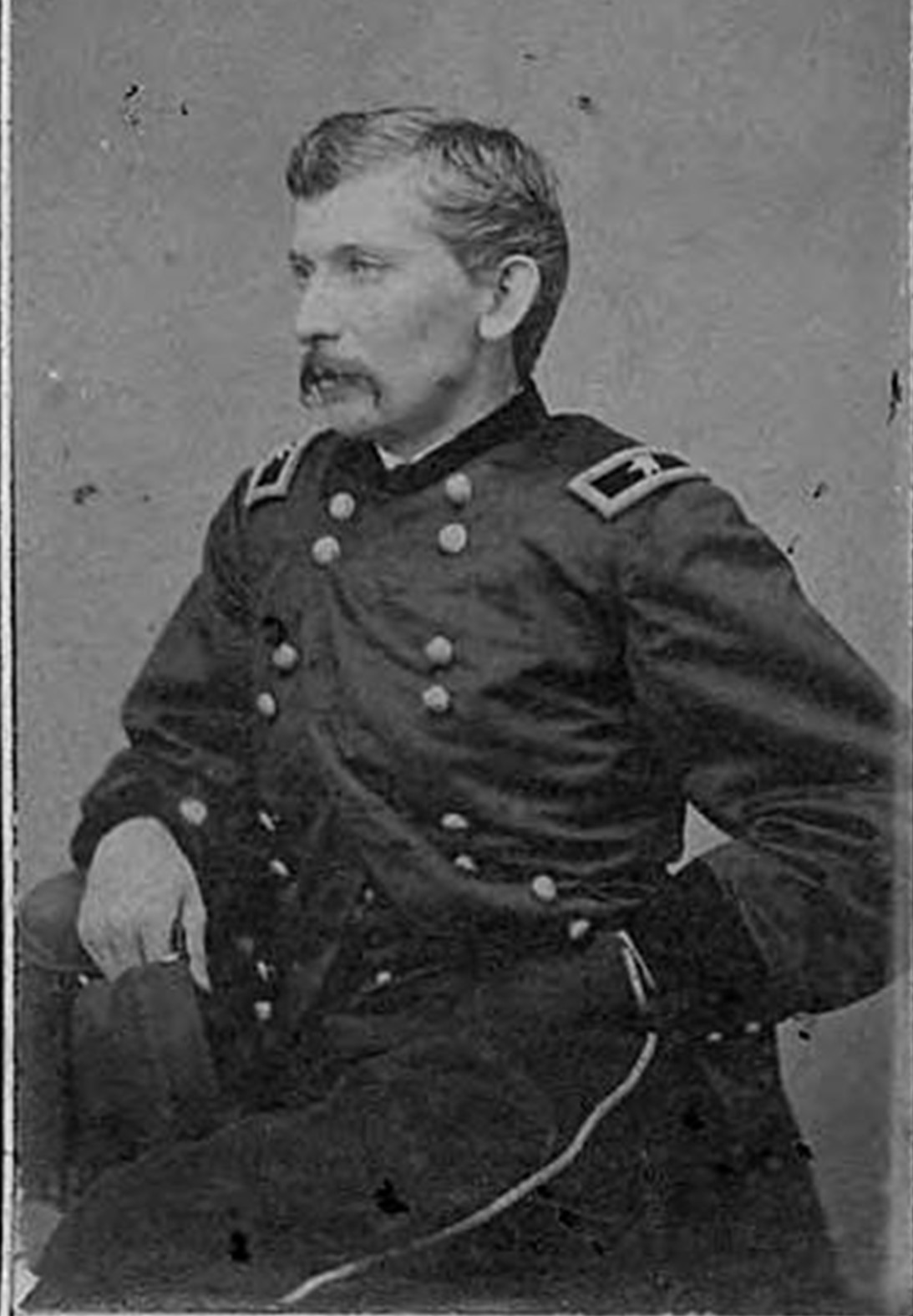
(Theodore Lilienthal – Portraits Collection, Public Domain)
At daybreak on December 29, 1890, Forsyth ordered the surrender of weapons and the immediate removal of the Lakota from the “zone of military operations” to awaiting trains. A search of the camp confiscated 38 rifles, and more rifles were taken as the soldiers searched the Lakota. None of the old men were found to be armed. A medicine man named Yellow Bird allegedly harangued the young men who were becoming agitated by the search, and the tension spread to the soldiers.
Specific details of what triggered the massacre are debated. According to some accounts, Yellow Bird began to perform the Ghost Dance, telling the Lakota that their “ghost shirts” were “bulletproof”. As tensions mounted, Black Coyote refused to give up his rifle; he spoke no English, was deaf, and had not understood the order. Another Lakota said: “Black Coyote is deaf,” and when the soldier persisted, he said, “Stop. He cannot hear your orders.” At that moment, two soldiers seized Black Coyote from behind, and (allegedly) in the struggle, his rifle discharged. At the same moment, Yellow Bird threw some dust into the air, and approximately five young Lakota men with concealed weapons threw aside their blankets and fired their rifles at Troop K of the Seventh Cavalry. After this initial exchange, the firing became indiscriminate.

Eyewitness accounts state that Black Coyote’s gun went off when he was seized from behind by soldiers. Survivor Wasumaza, one of Big Foot’s warriors who later changed his name to Dewey Beard, recalled Black Coyote was unable to hear. “If they had left him alone he was going to put his gun down where he should. They grabbed him and spinned [sic spun] him in the east direction. He was still unconcerned even then. He hadn’t [sic had] his gun pointed at anyone. He intended to put that gun down. They came on and grabbed the gun that he was going to put down. Right after they spun him around there was the report of a gun, which was quite loud. I couldn’t say that anyone was shot, but following that was a crash”. Theodor Ragnar of the Seventh Cavalry also stated that Black Coyote was deaf. In contrast, a Native American named Turning Hawk called Black Coyote “a crazy man, a young man of very bad influence, and in fact a nobody.”

mountain guns used at Wounded Knee
According to commanding General Nelson A. Miles, a “scuffle occurred between one deaf warrior who had [a] rifle in his hand and two soldiers. The rifle was discharged and a battle occurred, not only the warriors but the sick Chief Spotted Elk, and a large number of women and children who tried to escape by running and scattering over the prairie were hunted down and killed.”
At first, all firing was at close range; half the Lakota men were killed or wounded before they had a chance to get off any shots. Some of the Lakota grabbed rifles from the piles of confiscated weapons and opened fire on the soldiers. With no cover, and with many of the Lakota unarmed, this only lasted a few minutes. While the Lakota warriors and soldiers were shooting at close range, other soldiers used the Hotchkiss guns against the tepee camp full of women and children. It is believed that many of the soldiers were victims of friendly fire from their Hotchkiss guns. The Lakota women and children fled the camp and sought shelter from the crossfire in a nearby ravine. By this time, the officers had lost all control of their men. Some of the soldiers spread out, searched for, and killed the wounded. Other soldiers mounted their horses and hunted the Lakota (men, women, and children), in some cases for miles across the prairies. In less than an hour, at least 150 Lakota were killed and 50 wounded. Other estimates put the casualties at nearly 300 of the original 350 killed or wounded. with a blizzard preventing immediate search following the massacre. Reports indicate that the soldiers loaded fifty-one survivors (four men and forty-seven women and children) onto wagons and took them to the Pine Ridge Reservation. Army casualties numbered twenty-five dead. Black Coyote died at Wounded Knee.
Eyewitness Accounts
The following reports of witnesses illustrate the horror of December 29, 1890:
Suddenly, I heard a single shot from the direction of the troops. Then three or four. A few more. And immediately, a volley. At once came a general rattle of rifle firing then the Hotchkiss guns. — Thomas Tibbles (1840–1928), journalist
[T]hen many Indians broke into the ravine; some ran up the ravine and to favorable positions for defense. — Dewey Beard (Iron Hail, 1862–1955), Minneconjou Lakota survivor, as told to Eli S. Ricker
I did not know then how much was ended. When I look back now from this high hill of my old age, I can still see the butchered women and children lying heaped and scattered all along the crooked gulch as plain as when I saw them with eyes still young. And I can see that something else died there in the bloody mud, and was buried in the blizzard. A people’s dream died there. It was a beautiful dream. And I, to whom so great a vision was given in my youth, — you see me now a pitiful old man who has done nothing, for the nation’s hoop is broken and scattered. There is no center any longer, and the sacred tree is dead. — Black Elk (1863–1950), medicine man, Oglala Lakota
There was a woman with an infant in her arms who was killed as she almost touched the flag of truce … A mother was shot down with her infant; the child not knowing that its mother was dead was still nursing … The women as they were fleeing with their babies were killed together, shot right through … and after most all of them had been killed a cry was made that all those who were not killed or wounded should come forth and they would be safe. Little boys … came out of their places of refuge, and as soon as they came in sight a number of soldiers surrounded them and butchered them there. — American Horse (1840–1908), chief, Oglala Lakota
I know the men did not aim deliberately and they were greatly excited. I don’t believe they saw their sights. They fired rapidly but it seemed to me only a few seconds till there was not a living thing before us; warriors, squaws, children, ponies, and dogs … went down before that unaimed fire. — Edward S. Godfrey, captain, commanded Company D of the Seventh Cavalry (Godfrey was a lieutenant in Captain Benteen’s force during the Battle of the Little Bighorn)
General Nelson A. Miles, who visited the scene of carnage, following a three-day blizzard, estimated that around 300 snow shrouded forms were strewn over the countryside. He also discovered to his horror that helpless children and women with babies in their arms had been chased as far as two miles from the original scene of encounter and cut down without mercy by the troopers. .. Judging by the slaughter on the battlefield it was suggested that the soldiers simply went berserk. For who could explain such a merciless disregard for life? … As I see it the battle was more or less a matter of spontaneous combustion, sparked by mutual distrust. — Hugh McGinnis, First Battalion, Co. K, Seventh Cavalry
The whole trouble originated through interested whites, who had gone about most industriously and misrepresented the army and its movements upon all the agencies. The Indians were in consequence alarmed and suspicious. They had been led to believe that the true aim of the military was their extermination. The troops acted with the greatest kindness and prudence. In the Wounded Knee fight the Indians fired first. The troops fired only when compelled to. I was between both, saw all, and know from an absolute knowledge of the whole affair whereof I say. — The Reverend Father Francis M.J. Craft, Catholic missionary <6>
The Battle of White Clay Creek or
The Drexel Mission Fight
The Drexel Mission Fight was an armed confrontation between Lakota warriors and the United States Army that took place on the Pine Ridge Indian Reservation in South Dakota on December 30, 1890, the day after the Wounded Knee Massacre. The fight occurred on White Clay Creek, approximately 15 miles north of Pine Ridge, where Lakota were believed to have burned the Catholic Mission.
Seventh Cavalry under the command of Colonel James W. Forsyth, with eight troops and a battery of artillery (Battery E, 1st Artillery), the same elements engaged at Wounded Knee the previous day, became engaged by Brulé Lakota from the Rosebud Indian Reservation after reconnoitering to determine if the Catholic mission had been torched. These Indians were purported to be the same Brulé Lakota under Chief Two Strike that had attacked the Ninth Cavalry’s supply train earlier that morning. The Seventh Cavalry was hotly engaged in a valley by the combined Lakota forces while trying to break contact and withdraw. A battalion of the Ninth Cavalry, a Buffalo Soldier regiment under the command of Major Guy V. Henry and nicknamed the Henry’s Brunettes, responded to Forsyth’s request for assistance, and the combined cavalry forces drove the Lakota from commanding positions on the heights.
In an investigation of the Drexel Mission fight, Major General Nelson A. Miles, the commanding general of the Pine Ridge Campaign, severely criticized Forsyth for allowing his command to be pinned down in a valley. He submitted his findings as a supplement to his investigation of Forsyth’s conduct at Wounded Knee. Secretary of War Redfield Proctor set aside the Drexel Mission investigation after exonerating Forsyth of any wrongdoing at Wounded Knee.
Three soldiers were awarded the Medal of Honor for actions at White Clay Creek, including Captain Charles A. Varnum, First Sergeant Theodore Ragnar, and Farrier Richard J. Nolan. Almost three decades later Second Lieutenant Sedgwick Rice was awarded a Distinguished Service Medal. <7>
Aftermath

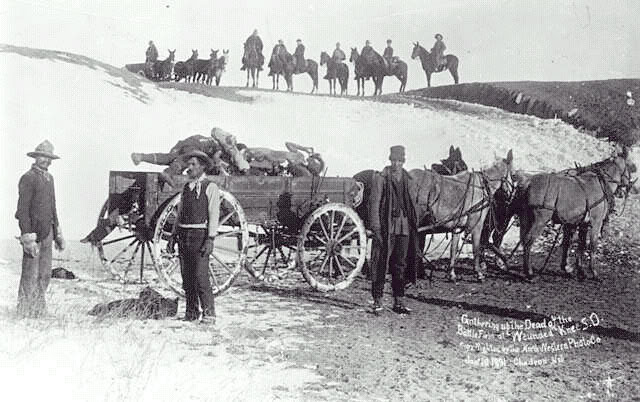
Following a three-day blizzard, the military hired civilians to bury the dead Lakota. The burial party found the deceased frozen; they were gathered up and placed in a mass grave on a hill overlooking the encampment from which some of the fire from the Hotchkiss guns originated. It was reported that four infants were found alive, wrapped in their deceased mothers’ shawls. In all, 84 men, 44 women, and 18 children reportedly died on the field, while at least seven Lakota were mortally wounded. Miles denounced Forsyth and relieved him of command. An exhaustive Army Court of Inquiry convened by Miles criticized Forsyth for his tactical dispositions but otherwise exonerated him of responsibility. The Court of Inquiry, however, was not conducted as a formal court-martial.

The Secretary of War agreed with the decision and returned Forsyth to the command of the Seventh Cavalry. Testimony had indicated that for the most part, troops attempted to avoid non-combatant casualties. Miles continued to criticize Forsyth, whom he believed had deliberately disobeyed his commands to destroy the Lakota. Miles promoted the conclusion that Wounded Knee was a deliberate massacre rather than a tragedy caused by poor decisions, to destroy the career of Forsyth. This was later whitewashed, and Forsyth was promoted to brigadier, then later, major general.
Soon after the event, Dewey Beard, his brother Joseph Horn Cloud, and others formed the Wounded Knee Survivors Association, which came to include descendants. They sought compensation from the U.S. government for the many fatalities and injuries. Today the association is independent and works to preserve and protect the historic site from exploitation, and to administer any memorial erected there. Papers of the association (1890–1973) and related materials are held by the University of South Dakota and are available for research. It was not until the 1990s that a memorial to the Lakota was included in the National Historic Landmark. In 1968 James Czywczynski purchased 40 acres of property adjacent to Wounded Knee, operating a trading post and museum.
More than eighty years after the massacre, the Wounded Knee battlefield was the site of the Wounded Knee incident. The protest began on February 27, 1973, and lasted seventy-one days. The standoff was between militants of the American Indian Movement and federal law enforcement officials. The American Indian Movement sought to draw attention to historical injustices and demand better treatment for Indigenous communities. The standoff had a profound impact on Native American rights and visibility.
Among the buildings destroyed were the Czywczynski post and Museum; the Czywczynskis moved away and asked for a purchase price of $3.9 million [land appraised at $14,000]. On September 7, 2022, the Oglala Sioux tribal council and the Cheyenne River Sioux Tribe voted to buy for $500,000 the 40-acre site from the Czywczynskis. (The Oglala Sioux tribal already owned one acre of Land from Wounded Knee which was donated by the Red Cloud Indian school on the site of the Sacred Heart church.) <8>

United States Army Units at Wounded Knee<7>
Colonel James W. Forsyth
Unit: Seventh U.S. Cavalry
West Point Graduate: 1856
Medal of Honor Recipient: No
Civil War Service: Yes
Other: Relieved by General Miles pending investigation.
Adjutant First Lieutenant Lloyd S. McCormack
Unit: Seventh U.S. Cavalry
West Point Graduate: 1876
Medal of Honor Recipient: No
Civil War Service: No
Other: Instrumental in the awards process following the campaign.
Quartermaster First Lieutenant Ezra B Fuller
Unit: Seventh U.S. Cavalry
West Point Graduate: 1873
Medal of Honor Recipient: No
Civil War Service: No
Other:
Assistant Surgeon and Medical Director Captain John Van Rennselaer Hoff
Unit: Seventh U.S. Cavalry
West Point Graduate: No
Medal of Honor Recipient: No
Civil War Service: No
Other: Distinguished Service Cross
Assistant Surgeon First Lieutenant James Denver Glennan
Unit: Seventh U.S. Cavalry
West Point Graduate: No
Medal of Honor Recipient: No
Civil War Service: No
Other: Commended for performance during the Ghost Dance War.
Major Samuel Whiteside
Unit: First Squadron Seventh U.S. Cavalry
West Point Graduate: No
Medal of Honor Recipient: No
Civil War Service: Yes <8>
Other:
Adjutant First Lieutenant William Jones Nicholson
Unit: First Squadron Seventh U.S. Cavalry
West Point Graduate: No
Medal of Honor Recipient: No
Civil War Service: No
Other: Commissioned an officer in the Seventh U.S. Cavalry
Captain Myles Moylan
Unit: First Squadron Troop A Seventh U.S. Cavalry
West Point Graduate: No
Medal of Honor Recipient: Year for Bear Paw Mountain
Civil War Service: Yes <9>
Other:
First Lieutenant Ernest A. Garlington
Unit: First Squadron Troop A Seventh U.S. Cavalry
West Point Graduate: 1876
Medal of Honor Recipient: Yes for Wounded Knee
Civil War Service: Np
Other:
Captain Charles A. Varnum
Unit: First Squadron Troop B Seventh U.S. Cavalry
West Point Graduate: 1872
Medal of Honor Recipient: Yes for White Clay Creek
Civil War Service: No
Other:
First Lieutenant John C. Gresham
Unit: First Squadron Troop A Seventh U.S. Cavalry
West Point Graduate: 1876
Medal of Honor Recipient: Yes for Wounded Knee
Civil War Service: No
Other:
Captain Henry J. Nowlan
Unit: First Squadron Troop I Seventh U.S. Cavalry
West Point Graduate: No
Medal of Honor Recipient: Yes for Wounded Knee
Civil War Service: Yes
Other: Commissioned in the Fourteenth New York Cavalry
Second Lieutenant John C. Waterman
Unit: First Squadron Troop I Seventh U.S. Cavalry
West Point Graduate: 1881
Medal of Honor Recipient: No
Civil War Service: No
Other:
Captain George D. Wallace
Unit: First Squadron Troop K Seventh U.S. Cavalry
West Point Graduate: 1872
Medal of Honor Recipient: No
Civil War Service: No
Other:
First Lieutenant James D. Mann
Unit: First Squadron Troop K Seventh U.S. Cavalry
West Point Graduate: 1877
Medal of Honor Recipient: No
Civil War Service: No
Other: Commended for action at White Clay Creek.
Captain Charles S. Isley
Unit: Second Squadron Troop A Seventh U.S. Cavalry
West Point Graduate: No
Medal of Honor Recipient: No
Civil War Service: No
Other:
Captain Henry Jackson
Unit: Second Squadron Troop C Seventh U.S. Cavalry
West Point Graduate: No
Medal of Honor Recipient: No
Civil War Service: No
Other:
Second Lieutenant T. Q. Donaldson
Unit: Second Squadron Troop C Seventh U.S. Cavalry
West Point Graduate: No
Medal of Honor Recipient: No
Civil War Service: No
Other:
Captain Edward S. Godfrey
Unit: Second Squadron Troop D Seventh U.S. Cavalry
West Point Graduate: 1867
Medal of Honor Recipient: No
Civil War Service: No
Other:
Second Lieutenant S. R. J. Tompkins
Unit: Second Squadron Troop D Seventh U.S. Cavalry
West Point Graduate: Dropped out of Academy
Medal of Honor Recipient: No
Civil War Service: Yes <10>
Other:
Captain Charles S. Isley
Unit: Second Squadron Troop E Seventh U.S. Cavalry
West Point Graduate: No
Medal of Honor Recipient: No
Civil War Service: No
Other: Captain of Secon Squadron and Troop E of Second Squadron
First Lieutenant Horatio G. Sickel
Unit: Second Squadron Troop E Seventh U.S. Cavalry
West Point Graduate: No
Medal of Honor Recipient: No
Civil War Service: Yes
Other:
Second Lieutenant Sedgwick Rice
Unit: Second Squadron Troop E Seventh U.S. Cavalry
West Point Graduate: No
Medal of Honor Recipient: No
Civil War Service: No
Other: Distinguished Service Medal for Actions at White Clay Creek
Captain Winfield S. Edgerly
Unit: Second Squadron Troop G Seventh U.S. Cavalry
West Point Graduate: 1870
Medal of Honor Recipient: No
Civil War Service: No
Other:
First Lieutenant Edwin P. Brewer
Unit: Second Squadron Troop G Seventh U.S. Cavalry
West Point Graduate: 1871
Medal of Honor Recipient: No
Civil War Service: No
Other:
Captain Allyn Capron
Unit: Battery E First U.S. Artillery
West Point Graduate: 1867
Medal of Honor Recipient: No
Civil War Service: No
Other: Commended for action at Wounded Knee and White Clay Creek.
Second Lieutenant Harry L. Hawthorne
Unit: Battery E First U.S. Artillery
West Point Graduate: No
Medal of Honor Recipient: Yes for Wounded Knee
Civil War Service: No
Other: 1882 graduate of U.S. Naval Academy
First Lieutenant George W. Taylor
Unit: Troop A Indian Scouts Ninth U.S. Cavalry
West Point Graduate: No
Medal of Honor Recipient: No
Civil War Service: No
Other:
Second Lieutenant Guy H. Preston
Unit: Troop A Indian Scouts Ninth U.S. Cavalry
West Point Graduate: 1888
Medal of Honor Recipient: No
Civil War Service: No
Other:
Medals of Honor

Medal of Honors Awarded for Battle of Wounded Knee Creek, South Dakota, December 29, 1890
William C. Austin – Sergeant, Company E, Seventh U. S. Cavalry ‒ “While the Indians were concealed in a ravine, assisted men on the skirmish line, directing their fire, etc., and using every effort to dislodge the enemy.”
John E. Clancy ‒ Musician, Company E, First U. S. Artillery ‒ “Twice voluntarily rescued wounded comrades under fire of the enemy.”- 1890 – Wounded Knee Creek, South Dakota
Mosheim Feaster ‒ Private, Company E, Seventh U. S. Cavalry ‒ “Extraordinary gallantry.” – 1890 – Wounded Knee Creek, South Dakota
Ernest A. Garlington ‒ First Lieutenant, Seventh U. S. Cavalry ‒ “Distinguished gallantry.”
John C. Gresham ‒ First Lieutenant, Seventh U. S. Cavalry ‒ “Voluntarily led a party into a ravine to dislodge Sioux Indians concealed therein. He was wounded during this action.”
Mathew H. Hamilton ‒ Private, Company G, Seventh U. S. Cavalry ‒ “Bravery in action.”
Joshua B. Hartzog ‒ Private, Company E, First U. S. Artillery ‒ “Went to the rescue of the commanding officer who had fallen severely wounded, picked him up, and carried him out of range of the hostile guns.”
Harry L. Hawthorne ‒ Second Lieutenant, Second U. S. Artillery ‒ “Distinguished conduct in battle with hostile Indians.”
Marvin C. Hillock ‒ Private, Company A, Seventh U. S. Cavalry ‒ “Distinguished bravery.”
George Hobday ‒ Private, Company A, Seventh U. S. Cavalry ‒ “Conspicuous and gallant conduct in battle.”
George Lloyd ‒ Sergeant, Company I, Seventh U. S. Cavalry ‒ “Bravery, especially after having been severely wounded through the lung.”
Albert W. McMillian ‒ Sergeant, Company E, Seventh U. S. Cavalry ‒ “While engaged with Indians concealed in a ravine, he assisted the men on the skirmish line, directed their fire, encouraged them by example, and used every effort to dislodge the enemy.”
Thomas Sullivan ‒ Private, Company E, Seventh U. S. Cavalry ‒ “Conspicuous bravery in action against Indians concealed in a ravine.”
Frederick E. Toy ‒ First Sergeant, Company G, Seventh U. S. Cavalry ‒ “Bravery.”
Jacob Trautman ‒ First Sergeant, Company I, Seventh U. S. Cavalry ‒ “Killed a hostile Indian at close quarters, and, although entitled to retirement from service, remained to the close of the campaign.”
James Ward ‒ Sergeant, Company B, Seventh U. S. Cavalry ‒ “Continued to fight after being severely wounded.”
Paul H. Weinert ‒ Corporal, Battery E, First U. S. Artillery ‒ “Taking the place of his commanding officer, who had fallen severely wounded, he gallantly served his piece, after each fire advancing it to a better position.”
Herman Ziegner ‒ Private, Company E, Seventh U. S. Cavalry ‒ “Conspicuous bravery.” <12><13>
In addition, three medals of honor were awarded to members of the Seventh Cavalry for actions at the Battle of White Clay Creek.
Richard J. Nolan ‒ Farrier, Company I, Seventh U. S. Cavalry ‒ “Bravery.”
Theodore Ragnar ‒ First Sergeant, Company K, Seventh U. S. Cavalry ‒ “Bravery.”
Charles A. Varnum ‒ Captain, Company B, Seventh U. S. Cavalry ‒ “While executing an order to withdraw, seeing that a continuance of the movement would expose another troop of his regiment to being cut off and surrounded, he disregarded orders to retire, placed himself in front of his men, led a charge upon the advancing Indians, regained a commanding position that had just been vacated, and thus insured a safe withdrawal of both detachments without further loss.” <14>
Efforts to Revoke Medals
For this 1890 campaign, the US Army awarded thirty-one Medals of Honor, nineteen specifically for service at Wounded Knee.
In 2001, the National Congress of American Indians passed two resolutions condemning the military awards and called on the federal government to rescind them. The Wounded Knee National Historic Landmark, the site of the massacre, has been designated a National Historic Landmark by the U.S. Department of the Interior. In 1990, the U.S. Congress passed a resolution on the historical centennial formally expressing “deep regret” for the massacre.
In the Nebraska State Historical Society’s summer 1994 quarterly journal, Jerry Green construes that pre-1916 Medals of Honor were awarded more liberally; however, “the number of medals does seem disproportionate when compared to those awarded for other battles.” Quantifying, he compares the three awarded for the Battle of Bear Paw Mountain’s five-day siege, to the twenty awarded for this short and one-sided action. Historian Will G. Robinson notes that, in contrast, only three Medals of Honor were awarded among the 64,000 South Dakotans who fought for four years of World War II. However, historian Dwight Mears points out that awards before 1918 were “Medal[s] of Honor in name only,” making such comparisons with modern medals inappropriate, since “the medal that existed in 1890 is a materially different award.”
Native American activists have urged the medals be withdrawn, calling them “medals of dishonor”. According to Lakota tribesman William Thunder Hawk, “The Medal of Honor is meant to reward soldiers who act heroically. But at Wounded Knee, they didn’t show heroism; they showed cruelty.” In 2001, the National Congress of American Indians passed two resolutions condemning the Medals of Honor awards and called on the U.S. government to rescind them.
Several of the citations on the medals awarded to the troopers at Wounded Knee state that they went in pursuit of Lakota who were trying to escape or hide. Another citation was for “conspicuous bravery in rounding up and bringing to the skirmish line a stampeded pack mule.” Another medal was awarded in part for extending an enlistment.
Recently, there have been efforts to revoke these Medals of Honor. In July 2022, the House of Representatives passed legislation to revoke the medals as an amendment to the fiscal 2023 defense policy bill. The bill, known as the “Remove the Stain Act,” aims to right a historical wrong and has garnered support from more than a dozen Native American tribes and advocacy groups. However, the Senate has not passed its version of the defense policy bill, and the two houses of Congress will need to agree on a compromise version of the legislation. While this represents progress, the outcome remains uncertain, as similar attempts in the past have faced challenges during the compromise process.
It’s essential to acknowledge and learn from such painful chapters in our shared history, even as we work toward justice and reconciliation. If the legislation succeeds, it will mark a significant step in recognizing the impact of the Wounded Knee Massacre and honoring the memory of those who suffered during that tragic event.
In February 2021, the South Dakota Senate unanimously called upon the United States Congress to investigate the twenty medals of honor awarded to members of the Seventh Cavalry for their participation in the massacre. Lawmakers argued that the medals given to the soldiers of the Seventh Cavalry Regiment tarnished Medals of Honor given to soldiers for genuine acts of courage. Previous efforts to rescind the medals have failed. In March 2021, Senators Elizabeth Warren (D-MA) and Jeff Merkley (D-OR) and Congressman Kaiali’i Kahele (D-HI) answered the South Dakota Senate’s call and reintroduced a bill to revoke the Medals of Honor awarded to the soldiers who perpetrated the Wounded Knee massacre. The provision was incorporated into the FY2022 National Defense Authorization Act, but was removed in conference with the explanation that “these Medals of Honor were awarded at the prerogative of the President of the United States, not the Congress.” This effectively expressed that since adjudication authority was granted to the executive, that it was not the role of Congress to revoke medals. As a result, the bill failed due to a separation of powers conflict. An identical version of Remove the Stain was added to the National Defense Authorization Act for Fiscal Year 2023 (2022); however, it was again removed from the final version of the defense bill by the Senate Armed Services Committee.
The Wounded Knee Survivors Association, formed by Dewey Beard, Joseph Horn Cloud, and other descendants, sought compensation from the U.S. government for the fatalities and injuries resulting from the 1890 Wounded Knee Massacre. Today, this independent association works to preserve the historic site and administer any memorials erected there.
In 1973, more than eighty years after the massacre, Wounded Knee became the site of the Wounded Knee incident—a seventy-one-day standoff between American Indian Movement militants and federal law enforcement. The incident destroyed buildings, including the Czywczynski Post and Museum. Recently, on September 7, 2022, the Oglala Sioux tribal council and the Cheyenne River Sioux Tribe purchased the 40-acre site from the Czywczynskis for $500,000. <15>
The Defense Department will review the Medals of Honor that were given to 20 U.S. soldiers for their actions in the 1890 battle at Wounded Knee to make sure their conduct merits such an honorable award.
Defense Secretary Lloyd Austin ordered the review by a special panel of experts after consultation with the White House and the Department of the Interior. Congress recommended such a review in the 2022 defense bill, reflecting a push by some lawmakers to rescind the awards for those who participated in the massacre on South Dakota’s Pine Ridge Indian Reservation near Wounded Knee Creek. <16>
The history of Wounded Knee is a powerful reminder of the struggles faced by Native American communities and the ongoing efforts to honor their heritage and seek justice.
Notes:
<1> “List of Indian massacres in North America,” Wikipedia, https://en.wikipedia.org/wiki/List_of_Indian_massacres_in_North_America.
<2> “Smallpox and the Native American,” American Journal of Medical Science, www.amjmedsci.com/article/S0002-9629(15)34481-5/fulltext.
<3> H.R.2226 — 117th Congress (2021-2022), Text – H.R.2226 – 117th Congress (2021-2022): Remove the Stain Act | Congress.gov | Library of Congress, https://www.congress.gov/bill/117th-congress/house-bill/2226/text.
<4> “The Ghost Dance,” Wikipedia, https://en.wikipedia.org/wiki/Ghost_Dance.
<2> “Wounded Knee Massacre,” Wikipedia, https://en.wikipedia.org/wiki/Wounded_Knee_Massacre
<2> Congressional Medal of Honor Society, https://www.cmohs.org/
<5> The M1875 Mountain Gun was a mountain gun that was used by the United States Army during the last quarter of the Nineteenth Century. A Hotchkiss design, “it was the first original breech-loading gun in the US Army”. It replaced the M1841 Mountain Howitzer in US Army service. It served with cavalry units during the late American Indian Wars, including the Wounded Knee Massacre, and was used during the Spanish–American War and Philippine–American War. It broke down into two loads for mule transport. Another mule was required for its ammunition. M1875 Mountain Gun, https://military-history.fandom.com/wiki/M1875_Mountain_Gun.
<6> “Drexel Mission Fight,” Wikipedia, https://www.wikiwand.com/en/Drexel_Mission_Fight.
<7> “Wounded Knee Massacre,” Wikipedia, https://en.wikipedia.org/wiki/Wounded_Knee_Massacre
<8> “Wounded Knee Massacre,” Wikipedia, https://en.wikipedia.org/wiki/Wounded_Knee_Massacre
<9> Whitside served in the Civil War in the Peninsular Campaign. He fought in the battles at Malvern Hill and Port Hudson. “Samuel Whitside,” Wikipedia, Samuel Whitside – Wikipedia.
<10> Moylan served in the Civil War and fought at the Battle of Gettysburg. “Myles Moylan,” Myles Moylan – Wikipedia.
<11> Tompkins fought in the Fairfax Courthouse, Virginia. One of the buildings from which the Confederates fired, the Union Hotel, was formerly managed by James Jackson, the innkeeper who had killed Col. Ellsworth on May 24, 1861. Sgt. Francis E. Brownell, in turn, killed Jackson. Brownell’s deed became the first wartime action recognized by a Medal of Honor. Tompkins was the second act recognized, though he did not receive his Medal until 1893. A year after he received the decoration, Tompkins retired as a colonel after a long military career. “June’s Hero, The Gallant Tompkins,” Military Images Digital, Charles Henry Tompkins received the Medal of Honor, militaryimagesmagazine-digital.com.
<12> Congressional Medal of Honor Society, https://www.cmohs.org/.
<13> Meaning of Words Used: Bravery – “the quality or state of having or showing mental or moral strength to face danger, fear, or difficulty.” Courage – “mental or moral strength to venture, persevere, and withstand danger, fear, or difficulty.” Distinction – “the quality or state of being excellent or superior.” Gallant – “spirited or brave.” Conduct – “to cause (oneself) to act or behave in a particular and especially in a controlled manner.”
<14> Congressional Medal of Honor Society, https://www.cmohs.org/.
<15> “Wounded Knee Massacre,” Wikipedia, https://en.wikipedia.org/wiki/Wounded_Knee_Massacre
<16> “Pentagon panel to review Medals of Honor given to soldiers at the Wounded Knee massacre,” https://www.wbtw.com/news/politics/ap-politics/ap-pentagon-panel-to-review-medals-of-honor-given-to-soldiers-at-the-wounded-knee-massacre/.
 Allen Mesch