Words Cannot Describe the Murders at Allen Premium Outlets

The tragic events in Allen, Texas incited me to explore words that were used in reports and comments about the murderous attack. My daughter-in-law was at Allen Premium Outlets and escaped harm. It was a terrifying experience that will take days, if not weeks, for all of us touched by this terrible violence.

Neutralize

This word was used by police about the killing of the shooter.

Merriam-Webster says “neutralize” is to counteract the activity or effect of or make ineffective; kill; or destroy.

Neutralize can mean captured, wounded, surrounded, as well as killed. Plain language would have helped here.

Condolences

Political figures used condolences to describe their response to the shooting.

Merriam-Webster says “condolence and condolences” means sympathy with another in sorrow or an expression of sympathy.

Senator John Cornyn: “I am grieving with the Allen community tonight, and I send my gratitude to the brave officers, Collin County first responders, and all of those involved in responding to this afternoon’s horrific incident.” The senator’s comments focus on the “first responders” (25 words) and not “grieving with the community (8 words).

Senator Ted Cruz: “Heidi and I are praying for the families of the victims of the horrific mall shooting in Allen, Texas. We pray also for the broader Collin County community that’s in shock from this tragedy.” Senator Cruz’s comments are more specific. He categorizes the shooting as “horrific” and tragic.

President Joe Biden said the Allen shooting is “too shocking to be so familiar.” Biden urges an assault weapon ban. President Joe Biden on Sunday urged Congress to send him a bill that bans assault weapons and high-capacity magazines. Biden said in a statement that the gunman who killed eight people at the Allen Premium Outlets used an AR-15-style semiautomatic rifle.

Keith Self, the United States representative for Texas’ third congressional district, made a statement shortly after the tragic shooting. The third congressional district encompasses areas north and northeast of Dallas, including Allen.

We are devastated by the tragic news of the shootings that took place at the Allen Premium Outlets today. Our prayers are with the victims and their families and all law enforcement on the scene. This is an ongoing situation, but Allen PD has full control of the scene. A shooter is down and there are multiple casualties. They are continuing to work to ensure the scene is safe. The public is being asked to stay away from that area while this investigation continues.

Representative Self’s comments focus on “law enforcement” (56 words) and not “tragic news” and “prayers” (28 words).

State Rep. Jeff Leach (R-McKinney) said, “There are many, many people in our community tonight who are hurting, whose lives have been shattered and who need and deserve our collected prayers.”

State Sen. Angela Paxton, who also represents the city of Allen, tweeted a statement that said in part, “We will never get over something like this, but we will get through it by being there for each other.”

Gov. Greg Abbott issued a statement saying, “I have been in contact with Mayor Fulk and DPS Director McCraw as well as other state and local leaders and offered the full support of the State of Texas to local officials.”

Our hearts are with the people of Allen, Texas tonight during this unspeakable tragedy. I have been in contact with Mayor Fulk and DPS Director McCraw as well as other state and local leaders and offered the full support of the State of Texas to local officials to ensure all needed assistance and resources are swiftly deployed, including DPS officers, Texas Rangers, and investigative resources.

Governor Abbott’s comments focus on law enforcement (51 words) and not “unspeakable tragedy” (14 words).

Lt. Governor Dan Patrick said in a statement, “Please join me in mourning the victims of the unspeakable tragedy in Allen. We are grateful for our brave first responders who were deployed to stop the shooter.”

Please join Jan and me in mourning the victims of the unspeakable tragedy in Allen. Please also join us in prayer for the victims’ families and friends along with the residents of Allen. We are grateful for our brave first responders who were deployed to stop the shooter and investigate this hideous crime. We are thankful for their bravery and courage.

Lt. Governor Patrick’s comments are more balanced.

State Rep. Rhetta Bowers (D-Garland), issued a statement that said in part, “It must be said that these tragedies will continue to occur so long as Texas fails to enact common sense gun safety reforms and invests in mental healthcare and the social safety net.”

California Governor Gavin Newsom urged Congress to pass gun control legislation, writing, “We have become a nation that is more focused on the right to kill than the right to live.”

Texas state Senator Roland Gutierrez, whose district includes the site of the Robb Elementary School Shooting, also called for more gun control, writing, “There is a special place in hell for people who watch all this happen and choose to do nothing.”

Representative

Merriam-Webster defines representative as serving to represent, standing, or acting for another, especially through delegated authority, and of, based on, or constituting a government in which the many are represented by persons chosen from among them usually by election.

Accessory

I believe that it is time to change the description of politicians as representatives of the people, but rather as accessories. Merriam-Webster defines accessory as a person not actually or constructively present but contributing as an assistant or instigator to the commission of an offense (also called accessory before the fact) and a person who knowing that a crime has been committed aids or shelters the offender with intent to defeat justice (also called accessory after the fact).

Condemning

The public has condemned the statements made by Texas politicians. This seems an appropriate response because Merriam-Webster defines condemning to declare to be reprehensible, wrong, or evil usually after weighing evidence and without reservation.


Please pray for the families affected and for all who have been touched by this monstrous killing.

I hope you will consider these words as you try to understand these murders and the failure of the accessories to take measures to decrease these tragic events.


If you like this post, please follow me at http://www.allenmesch.com


Posted in Scratch Pad | Tagged , | Leave a comment

Authors Relax – Artificial Intelligence is Not Ready to Replace You

Artificial intelligence is used in many ways today. It is used to provide personalized recommendations to people based on their previous searches and purchases or other online behavior1. It is also used in web searches, digital personal assistants, machine translations, smart homes, cities and infrastructure, and fighting disinformation. AI is also used in facial recognition technology, spam detection, credit card fraud detection, and more.[1]

You can use CPT-3 to write books. The rise of widely available, easy-to-use artificial intelligence tools is creating a new genre of robot-generated literature. Amazon already offers over 200 books (and climbing) with GPT-3 listed as an author or co-author.

GPT-3 is a machine learning model and not a substitute for your own creativity and writing skills. GPT-3 can provide you with a lot of information and inspiration that you can use to write your book.[2]

If you’re supposed to write a summary for school or work on a body of text, AI chatbots like GPT-3 can be used to make summarizing long articles, research papers, and books an easier task.

It is not possible to cite your sources with GPT-3. You can create citations, but it isn’t designed for this task and it tends to make up sources that don’t exist or present information in the wrong format. GPT-3 also cannot add citations to direct quotes in your text. If you’re looking for a more reliable source for your research, I would recommend using a database or search engine that specializes in academic sources such as Google Scholar or JSTOR.[3]

Here are some tips on how to write effective GPT-3 prompts12:

  • Start with a clear goal of what you want the output to accomplish.
  • Keep it simple and concise.
  • Use keywords strategically.
  • Provide ample context.
  • Use examples when possible.

GPT-3 can be used to write blogs. However, it is important to note that GPT-3 is not at a point where you can click a button and magically have a great blog post. It is also important to keep in mind that the content generated by GPT-3 may not always be accurate or reliable.[4]

Historians can use GPT-3 to generate summaries of historical events or write articles about historical figures. However, it is important to keep in mind that the content generated by GPT-3 may not always be accurate or reliable.[5]

CPT-3 is an AI language model that can generate human-like text. It is designed to generate text that is similar to human writing. Wikipedia is a free online encyclopedia that anyone can edit. It contains articles on almost every topic and is written by volunteers from around the world.

While CPT-3 can generate text on any topic, it may not always be accurate or reliable. Wikipedia articles are written by volunteers who may not be experts in the field, but they are usually reviewed by other editors and are often based on reliable sources.[6]

I wrote this blog using CPT-3 as offered by Microsoft Bing.  The questions I asked are shown below. One of the most used responses to my questions was CPT-3 “may not always be accurate or reliable.” That seems a very bad start for any non-fiction writing. I also didn’t like that “it is not possible to cite your sources with GPT-3.”

So for now, this author will not jump into the AI pool.


[1] How do we use artificial intelligence today?

[2] Can you use CPT-3 to write books?

[3] Can CPT-3 generate sources and citations?

[4] Can you use GPT-3 to write blogs?

[5] How can historians use CPT-3?

[6] How does CPT-3 compare with Wikipedia?

Posted in Scratch Pad | Tagged | Leave a comment

One Hundred Books You Must Read Before You Die

I watched The Enforcer recently and was intrigued by the hero’s goal of reading a hundred books you must read. In response, I obtained the following list of books you must read.

[CHILD] – 33 titles are suitable for children and adults.

[READ] – I have read 16 of the titles. I’ve got a lot of work ahead of me.

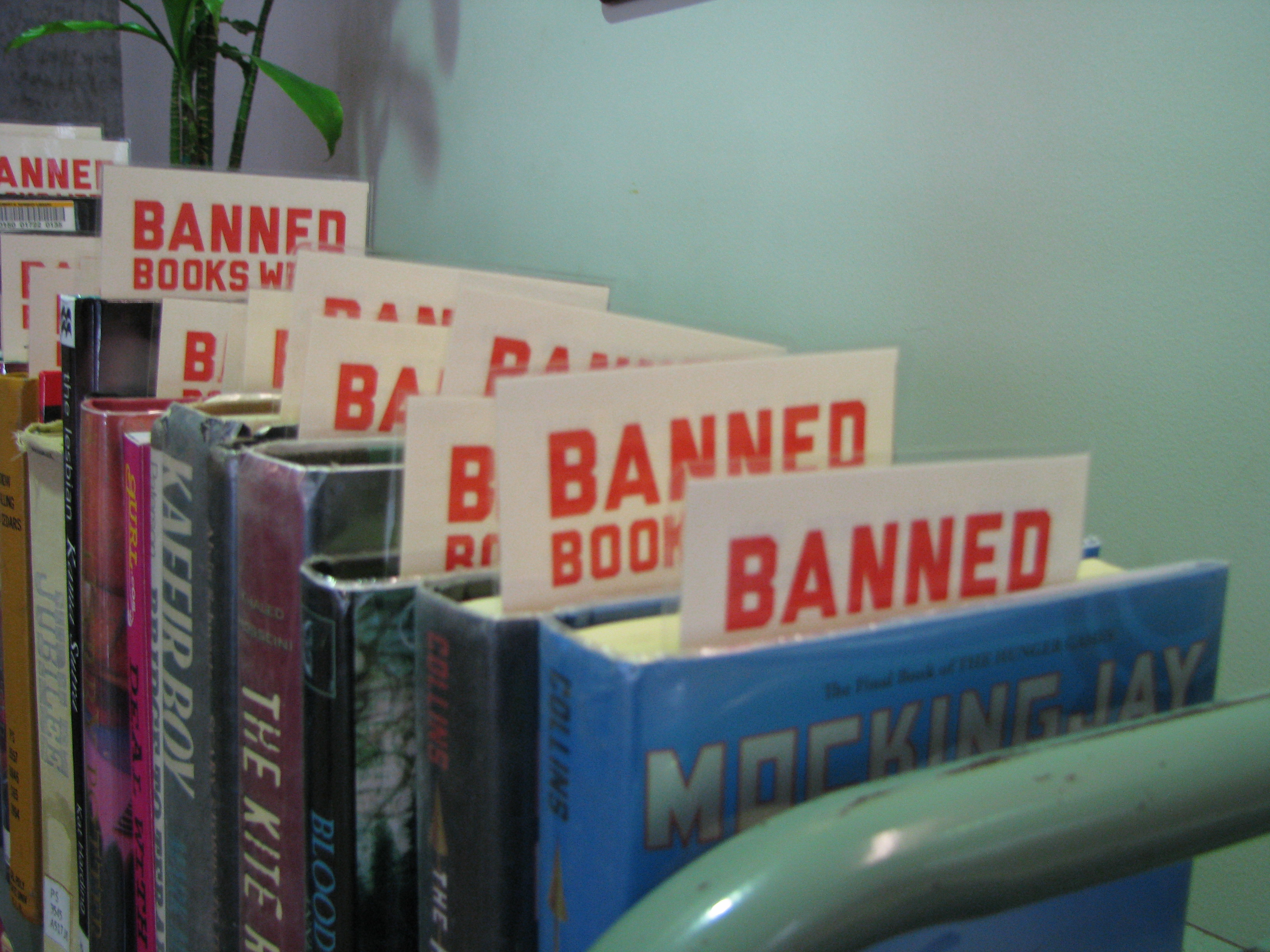
[BANNED] – 22 books are banned in Texas and other states.

1. 1984 by George Orwell [BANNED]

2. Adventures of Huckleberry Finn by Mark Twain [CHILD] [READ] [BANNED]

3. The Adventures of Sherlock Holmes by Arthur Conan Doyle

4. The Alchemist by Paulo Coelho

5. The Aleph and Other Stories by Jorge Luis Borges

6. Animal Farm by George Orwell [BANNED]

7. Aesop’s Fables by Aesop [CHILD] [READ]

8. Alice’s Adventures in Wonderland by Lewis Carroll [CHILD]

9. Anna Karenina by Leo Tolstoy

10. Anne of Green Gables by L.M. Montgomery

11. As I Lay Dying by William Faulkner [BANNED]

12. Beloved by Toni Morrison [BANNED]

13. The Book Thief by Markus Zusak [CHILD]

14. Brave New World by Aldous Huxley [BANNED]

15. The Brothers Karamazov by Fyodor Dostoevsky [READ]

16. Catch-22 by Joseph Heller

17. The Catcher in the Rye by J.D. Salinger [BANNED]

18. Charlie and the Chocolate Factory by Roald Dahl [CHILD]

19. Charlotte’s Web by E. B White [CHILD] [BANNED]

20. The Call of the Wild by Jack London [CHILD]

21. A Clockwork Orange by Anthony Burgess [BANNED]

22. The Code of the Woosters by P.G. Wodehouse

23. The Collected of Edgar Allan Poe by Edgar Allan Poe

24. The Color Purple: A Novel by Alice Walker [BANNED]

25. Coraline by Neil Gaiman [CHILD]

26. The Count of Monte Cristo by Alexandre Dumas [CHILD]

27. Crime and Punishment by Fyodor Dostoyevsky [READ]

28. The Curious Incident of the Dog in the Night-Time by Mark Haddon [CHILD]

29. The Death of Artemio Cruz by Carlos Fuentes

30. Diary of a Madman and Other Stories by Lu Xun

31. Anne Frank: The Diary of a Young Girl by Anne Frank [CHILD] [BANNED]

32. The Divine Comedy by Dante Alighieri

33. Don Quixote by Miguel de Cervantes Saavedra [READ]

34. Dracula by Bram Stoker

35. Emma by Jane Austen

36. Fahrenheit 451 by Ray Bradbury [BANNED]

37. Frankenstein by Mary Shelley

38. The Giver by Lois Lowry

39. The Golden Compass by Philip Pullman [CHILD]

40. Goodnight Moon by Margaret Wise Brown [CHILD]

41. Great Expectations by Charles Dickens

42. The Great Gatsby by F. Scott Fitzgerald [BANNED]

43. Grimm’s Fairy Tales by Jacob and Wilhelm Grimm [CHILD] [READ]

44. Gulliver’s Travels by Jonathan Swift [CHILD] [READ]

45. Hamlet by William Shakespeare [READ]

46. The Handmaid’s Tale by Margaret Atwood [BANNED]

47. Harry Potter by J.K. Rowling [CHILD] [BANNED]

48. Heart of Darkness by Joseph Conrad [READ]

49. Here’s to You, Jesusa! by Elena Poniatowska

50. The Hitchhiker’s Guide to the Galaxy by Douglas Adams

51. The Hobbit by J. R. R. Tolkien [CHILD]

52. Holes by Louis Sachar [CHILD]

53. Hopscotch by Julio Cortázar

54. The Iliad by Homer [READ]

55. Invisible Man by Ralph Ellison [BANNED]

56. Jane Eyre by Charlotte Brontë

57. Journey to the Center of the Earth by Jules Verne [CHILD]

58. Les Misérables by Victor Hugo

59. Life of Pi by Yann Martel

60. The Lion, the Witch and the Wardrobe by C. S. Lewis [CHILD]

61. The Little Prince by Antoine de Saint-Exupéry [CHILD]

62. Little Women by Louisa May Alcott [CHILD]

63. Lolita by Vladimir Nabokov [BANNED]

64. The Lord of the Rings by J.R.R. Tolkien [CHILD] [BANNED]

65. Love in the Time of Cholera by Gabriel Garcia Marquez

66. Madame Bovary by Gustave Flaubert

67. Metamorphosis by Franz Kafka

68. Moby-Dick by Herman Melville [READ]

69. Mrs. Dalloway by Virginia Woolf

70. Murder on the Orient Express by Agatha Christie

71. Of Mice and Men by John Steinbeck [BANNED]

72. The Old Man and the Sea by Ernest Hemingway [CHILD] [READ]

73. Oliver Twist by Charles Dickens [CHILD]

74. One Hundred Years of Solitude by Gabriel Garcia Marquez

75. One Thousand and One Nights by Unknown

76. A Passage to India by E.M. Forster

77. Pedro Páramo by Juan Rulfo

78. The Phantom Tollbooth by Norton Juster [CHILD]

79. Pippi Longstocking by Astrid Lindgren [CHILD]

80. Pride and Prejudice by Jane Austen

81. The Remains of the Day by Kazuo Ishiguro

82. Romeo and Juliet by William Shakespeare [READ]

83. A Series of Unfortunate Events by Lemony Snicket [CHILD]

84. The Shadow of the Wind by Carlos Ruiz Zafón

85. Slaughterhouse-Five by Kurt Vonnegut

86. The Sound of the Mountain by Yasunari Kawabata

87. The Stranger by Albert Camus

88. The Tale of Genji by Murasaki Shikibu

89. Things Fall Apart by Chinua Achebe

90. The Three Musketeers by Alexandre Dumas [CHILD]

91. To Kill a Mockingbird by Harper Lee [CHILD] [READ] [BANNED]

92. Treasure Island by Robert Louis Stevenson [CHILD] [READ]

93. Ulysses by James Joyce

94. War and Peace by Leo Tolstoy [READ]

95. Watership Down by Richard Adams [CHILD]

96. Winnie-the-Pooh by A. A. Milne [CHILD]

97. The Woman in White by Wilkie Collins

98. The Wonderful Wizard of Oz by L. Frank Baum [CHILD]

99. A Wrinkle in Time by Madeleine L’Engle

100. Wuthering Heights by Emily Brontë

Of the 1,648 titles on the PENN AMERICA banned book list for the 2021-2022 school year:

41% explicitly address LGBTQ+ themes or have protagonists or prominent secondary characters who are LGBTQ+ (this includes a specific subset of titles for transgender characters or stories – 145 titles, or 9%)

40% contain protagonists or prominent secondary characters of color;

21% directly address issues of race and racism;

22% contain sexual content of varying kinds, including novels with some level of description of the sexual experiences of teenagers, stories about teen pregnancy, sexual assault, and abortion as well as informational books about puberty, sex, or relationships.

PEN AMERICA INDEX OF SCHOOL BOOK BANS – 2021-2022, https://pen.org/banned-book-list-2021-2022/, retrieved April 18, 2023.

Posted in Scratch Pad | Tagged , | Leave a comment

“My undertaking is not difficult, essentially… I should only have to be immortal to carry it out.”

Jorge Luis Borges (August 24, 1899 – June 14, 1986) was an Argentine writer who is considered one of the foremost literary figures of the Twentieth Century. He is famous for his short stories and fictive essays, Borges was also a poet, critic, translator, and man of letters.

I became acquainted with Mr. Borges from a LinkedIn posting of one of his quotes.

Of all man’s instruments, the most wondrous, no doubt, is the book. The other instruments are extensions of his body. The microscope, the telescope, are extensions of his sight; the telephone is the extension of his voice; then we have the plow and the sword, extensions of the arm. But the book is something else altogether: the book is an extension of memory and imagination.


(Source: Jorge Luis Borges, Wikiquote, https://en.wikiquote.org/wiki/Jorge_Luis_Borges, Retrieved April 10, 2023)

I have selected several of Mr. Borges quotes to contemplate and inspire my fellow authors.

On Writing

It is worth remembering that every writer begins with a naively [sic naïve] physical notion of what art is. A book for him or her is not an expression or a series of expressions, but literally a volume, a prism with six rectangular sides made of thin sheets of papers which should include a cover, an inside cover, an epigraph in italics, a preface, nine or ten parts with some verses at the beginning, a table of contents, an ex libris with an hourglass and a Latin phrase, a brief list of errata, some blank pages, a colophon and a publication notice: objects that are known to constitute the art of writing.

Writing is nothing more than a guided dream.

A writer — and, I believe, generally all persons — must think that whatever happens to him or her is a resource. All things have been given to us for a purpose, and an artist must feel this more intensely. All that happens to us, including our humiliations, our misfortunes, our embarrassments, all is given to us as raw material, as clay, so that we may shape our art.

The central problem of novel-writing is causality.

Writing long books is a laborious and impoverishing act of foolishness: expanding in [sic into] five hundred pages an idea that could be perfectly explained in a few minutes. A better procedure is to pretend that those books already exist and to offer a summary, a commentary.

Reading … is an activity subsequent to writing: more resigned, more civil, more intellectual.

Every novel is an ideal plane inserted into the realm of reality.

Imprecision is tolerable and verisimilar in literature, because we always tend towards it in life.

Ts’ui Pe must have said once: I am withdrawing to write a book. And another time: I am withdrawing to construct a labyrinth. Every one imagined two works; to no one did it occur that the book and the maze were one and the same thing.

Like every writer, he measured the virtues of other writers by their performance, and asked that they measure him by what he conjectured or planned.

(Source: Jorge Luis Borges, Wikiquote, https://en.wikiquote.org/wiki/Jorge_Luis_Borges, Retrieved April 10, 2023)

On History

That history should have imitated history was already sufficiently marvellous; that history should imitate literature is inconceivable….

Perhaps universal history is the history of the diverse intonation of some metaphors.

It may be that universal history is the history of the different intonations given a handful of metaphors.

One literature differs from another, either before or after it, not so much because of the text as for the manner in which it is read.

(Source: Jorge Luis Borges, Wikiquote, https://en.wikiquote.org/wiki/Jorge_Luis_Borges, Retrieved April 10, 2023)

On Books

A book is more than a verbal structure or series of verbal structures; it is the dialogue it establishes with its reader and the intonation it imposes upon his voice and the changing and durable images it leaves in his memory. A book is not an isolated being: it is a relationship, an axis of innumerable relationships.

A book is not an autonomous entity: it is a relation, an axis of innumerable relations. One literature differs from another, be it earlier or later, not because of the texts but because of the way they are read: if I could read any page from the present time — this one, for instance — as it will be read in the year 2000, I would know what the literature of the year 2000 would be like.

In the beginning of literature there is myth, as there is also in the end of it.

(Source: Jorge Luis Borges, Wikiquote, https://en.wikiquote.org/wiki/Jorge_Luis_Borges, Retrieved April 10, 2023)

Posted in Scratch Pad | Leave a comment

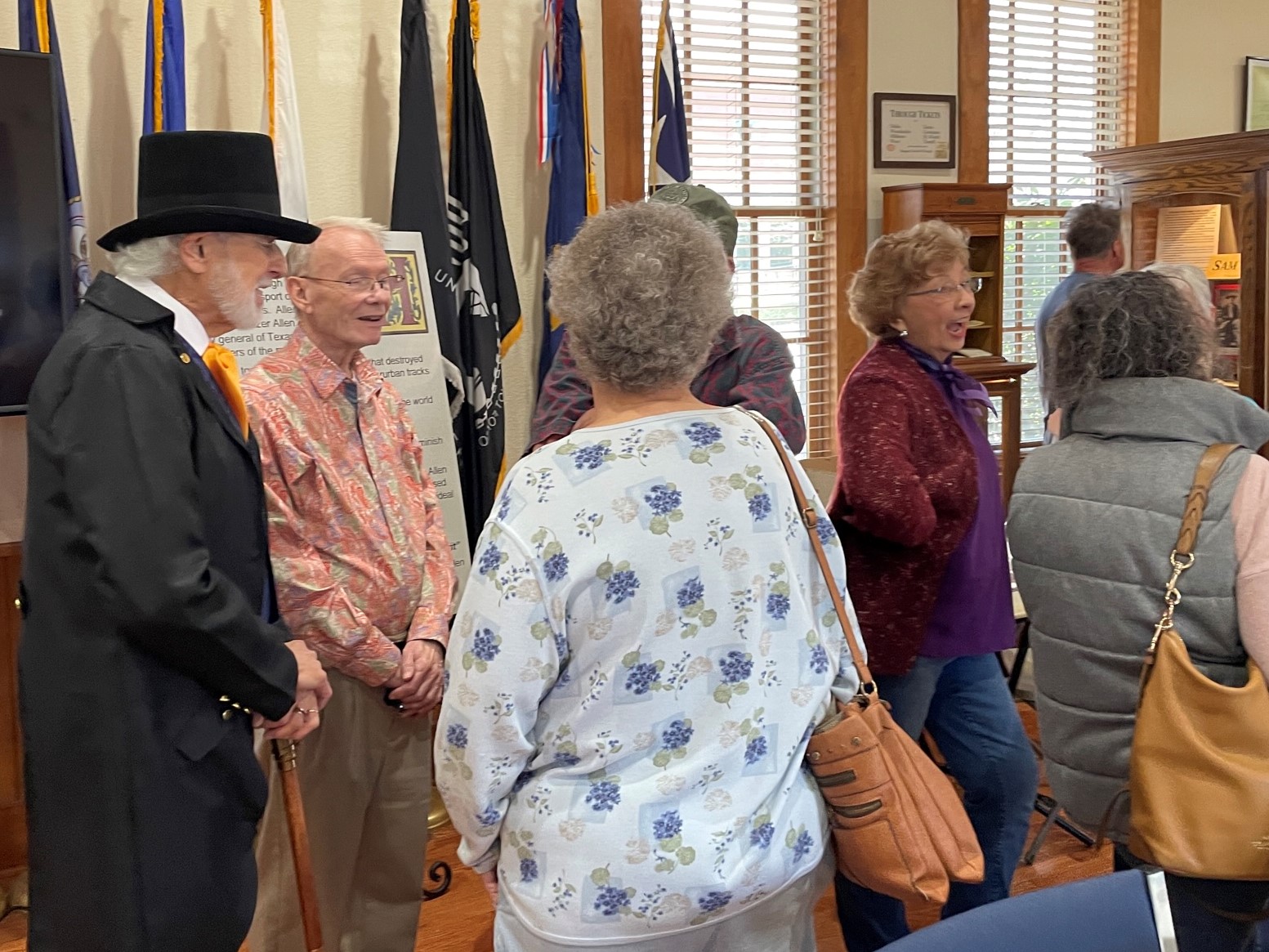
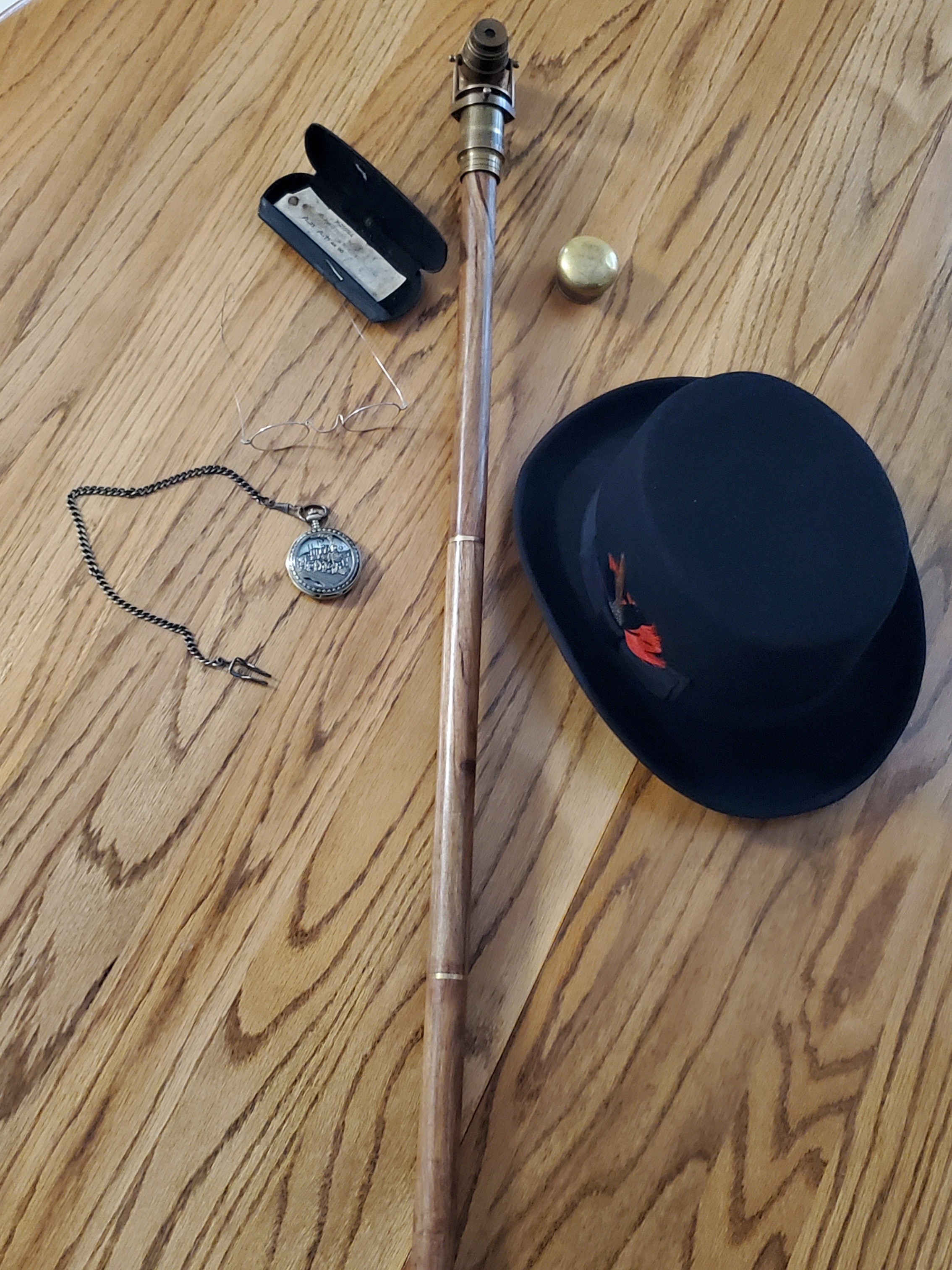
Ebenezer Allen Living Historian at Allen Heritage Depot

On March 25, 2023, I had the pleasure of appearing as Ebenezer Allen at the Allen Heritage Depot. I told the visitors about Allen’s life and his contributions as an entrepreneur and statesman.

Check out these pictures of me from November 2019 at the depot.

Other images of the depot and the Houston and Texas Central Railroad.

Here are a few pictures from the event.

Mr. Ed Byran of the Allen Historical Guild provided some additional photos.

Posted in Scratch Pad | Tagged | Leave a comment

Speaking Events and Classes

Beginning in March, I will speak at several events in north Texas.

Ebenezer Allen at Allen Depot Museum

From 1:00-3:00 pm on March 25, 2023, I will be at Allen Train Depot Museum to discuss my biography of Ebenezer Allen, The Forgotten Texas Statesman. I will be dressed in my living historian costume and sell copies of the first edition of my biography of Mr. Allen.

A Visit with Ebenezer Allen

From 10:30-11:30 am on June 22, 2023, I will be presenting a PowerPoint presentation on Ebenezer Allen. I will be dressed in my living historian costume. The presentation is being hosted by SAIL.

Contact SAIL for further information. SAIL members are invited to bring a guest.

Writing Class – Class One – Starting Writing

I will be conducting an introduction to writing class for the Plano Parks and Recreation Department in July 2023. The class will be presented at the Sam Johnson Senior Center in Plano.

Class One – Starting Writing

  • Session 1 – Reasons to Write
  • Session 2 – Structure, Plot, and Save the Cat
  • Session 3 – Observation and Research
  • Session 4 – Sloppy Writing

If this class is successful, I will conduct two other four session classes: From Writer to Author and Getting Published.


Posted in Scratch Pad | Leave a comment

Are Book Bans Un-American?

Louis A. Bedford IV writes “Book bans are un-American” in an editorial in the March 5, 2023 edition of The Dallas Morning News. As in all things in Texas, book banning is the biggest in the Lone Star state. Texas leads the nation with 800 books. Dan Solomon’s article in the September issue of Texas Monthly reports that Texas, Florida, Pennsylvania, and Tennessee accounted for more than 85% of the total book bans.

Mr. Bedford cites two Supreme Court cases that ruled against book banning as a violation of students’ right to books.

Bedford writes that book banning restricts “the free access of the most powerful tool at our disposal: information.” He adds that banning books because the “views they include … goes against the ideals of Americanism.”

“The banning of books and information paves a dangerous road toward tyranny.”

“By standing up for intellectual freedom and opposing book banning and other limits to information, we can help ensure that our society remains one that values knowledge, critical thinking, and individual autonomy – the true values of America.”[1]

Why Are Books Banned?

Banned books are books or other printed works such as essays or plays which are prohibited by law or to which free access is not permitted by other means. The practice of banning books is a form of censorship, for political, legal, religious, moral, or (less often) commercial motives. The Freedom to Read Website lists notable banned books and works with a brief explanation of why the books were prohibited. Banned books include fictional works such as novels, poems, and plays and non-fiction works such as biographies and dictionaries.

Historically, banning books or censoring texts are often seen when authoritarian regimes try to suppress certain messages it does not want to spread. Pre-World War II Germany saw mass book burnings and bans that tried to remove any statements which positively portrayed Jewish people. Banning and censoring texts is often portrayed as a restriction of First Amendment rights.[2]

The Freedom to Read Website provides “a selective timeline of book bannings, burnings, and other censorship activities.”

First Ammendment Protection

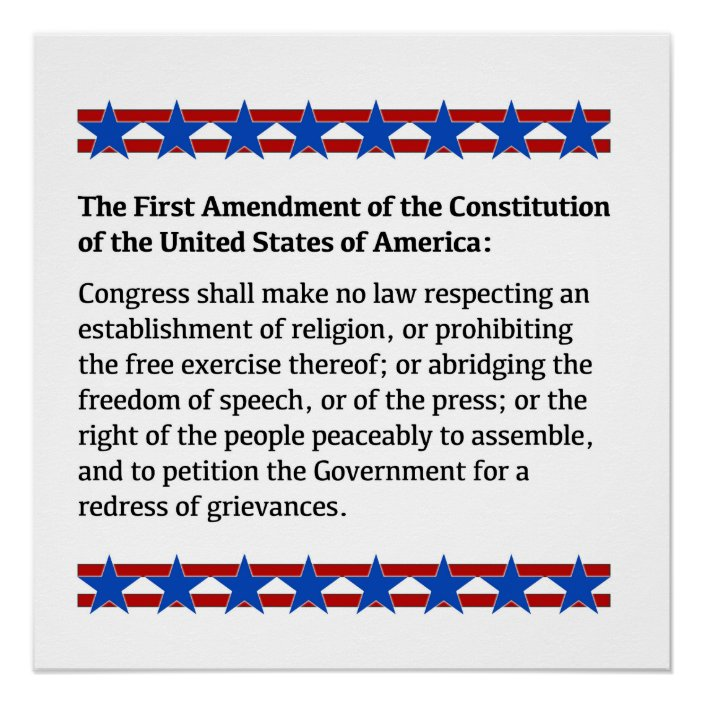
The First Amendment protects individuals against the government’s “abridging the freedom of speech.” However, government actions that are sometimes labeled as censorship may not be violations of these constitutional rights. Banning books by schools and libraries is not always classified as constitutional or unconstitutional, because “censorship” is a colloquial term, not a legal term.

Colloquialism which is also called colloquial language, everyday language, or general parlance, is the language style used for casual or informal communication. It is the most common functional style of speech. It is the language that is normally used in conversation and other informal contexts.[3]

Some principles can illuminate whether and when book banning is unconstitutional.

Censorship does not violate the Constitution unless the government does it.

For example, if the government tries to forbid certain types of protests solely because of the viewpoint of the protesters, that is an unconstitutional restriction on speech. The government cannot create laws or allow lawsuits that keep you from having particular books on your bookshelf unless the substance of those books fits into a narrowly defined unprotected category of speech such as obscenity or libel. Even these unprotected categories are defined in precise ways that are still very protective of speech.

However, the government may enact reasonable regulations that restrict the “time, place or manner” of your speech. It must do so in ways that are content- and viewpoint-neutral. The government cannot restrict an individual’s ability to produce or listen to speech based on the topic of the speech or the ultimate opinions expressed.

If the government does try to restrict speech in these ways, it is probably unconstitutional censorship.

What is Not Unconstitutional

In contrast, when private individuals, companies, and organizations create policies or engage in activities that suppress people’s ability to speak, these private actions don’t violate the Constitution.

Private actions can have a major impact on a person’s ability to speak freely and the creation and distribution of ideas. Book burning or the actions of private universities in punishing faculty for sharing unpopular ideas prohibits free discussion and unrestrained development of ideas and knowledge.

When Schools Can Ban Books

It’s hard to definitively say whether the current incidents of book banning in schools are constitutional. This is because decisions made in public schools are analyzed by the courts differently from censorship in nongovernment contexts.

According to the Supreme Court, control over public education is for “the most part” given to “state and local authorities.” The government has the power to determine what is appropriate for students and thus the curriculum at their school.

However, students retain some First Amendment rights. Public schools may not censor students’ speech, either on or off campus, unless it is causing a “substantial disruption.”

Government and school officials may exert control over the school curriculum without violating students’ or educators’ free-speech rights.

There are exceptions to the government’s power over the school curriculum. The Supreme Court ruled that a state law banning a teacher from covering the topic of evolution was unconstitutional because it violated the establishment clause of the First Amendment, which prohibits the state from endorsing a particular religion.

School boards and state legislators usually have the final decision over what schools teach. State regulation of curriculum is generally constitutionally permissible unless they violate some other provision(s) of the Constitution.

Schools with limited resources have the discretion to determine which books to add to their libraries. However, several members of the Supreme Court have written that removal is constitutionally permitted only if it is done based on the educational appropriateness of the book, not because it was intended to deny students access to books with which school officials disagree.

The Next Step

Even though the government has the option to control what’s taught in school, the First Amendment ensures the right of free speech to those who want to protest what’s happening in schools.[4]

Parents have the right to prohibit their children from reading specific books or discussing certain topics. This authority has been in effect for many years. I object when a parent or group of parents enforces their wishes on all students. Parents have the right to complain about this because it denies their student(s) access to books. Students also have the right to read and discuss books outside of school.

I am also alarmed at the book-banning techniques used by groups to attack, slander, and threaten teachers, librarians, school board members, and other individuals who oppose their actions. These heavy-handed measures have no place in public discourse.  

Groups Fighting Book Bans


[1] Louis A. Bedford IV, “Book bans are un-American,” The Dallas Morning News, March 5, 2023.

[2] Bannings and Burnings in History, Freedom to Read Website,  retrieved March 5, 2023.

[3] Colloquialism, Wikipedia, retrieved March 5, 2023.

[4]When are book bans unconstitutional? A First Amendment scholar explains,” The Free Speech Center at Middle Tennessee University, retrieved March 5, 2023.

Posted in Scratch Pad | Tagged , | Leave a comment

Americans Agree on Teaching Our Achievements and Failures

In an editorial in The Dallas Morning News on February 26, 2023, Dan Vallone writes “there is significant common ground in how Americans feel our history should be taught.”

Dan Vallone’s report by his organization, More in Common,  concludes “most Americans agree on the basic principles of how we learn about our nation’s past, including how to teach issues surrounding America’s history of racism.” Defusing the History Wars: Finding Common Ground in Teaching America’s National Story study also revealed: “Americans, irrespective of their demographic or ideological backgrounds, mistakenly believe the country is split into two hostile camps with irreconcilable beliefs on how to teach American history.”

Vallone says that there are perception gaps between what other Americans believe compared to what we think they believe. He believes: “Such perception gaps — the difference between what other Americans believe vs. what we think they believe — turn potential allies into enemies.”

The report provides the following examples:

Democrats believe that only 30% of Republicans feel we should teach both our shared national history as well as the history of specific groups of Americans such as Black, Hispanic, and Native Americans.  An overwhelming majority of Republicans, 72%, hold this view. Similarly, Republicans believe that only 42% of Democrats think that George Washington and Abraham Lincoln should be admired for their roles in American history when in fact, close to 90% of Democrats feel this way.

There are important areas where Americans diverge on the topic of history.

72% of Republicans believe the history of minority groups is prioritized over history that elevates a common identity while 72% of Democrats say this is not the case.

However, I wonder what is more critical in going forward: perceptions or reality? Political discussions seem to be void of facts or reality. The merits of elected officials are distorted to create the desired political perception. Was Donald Trump a good president? Is Joe Biden a bad president? The achievements and failures of both chief executives are riddled with lies. Another example is the 2020 Presidential Election. There are some who believe Donald Trump was reelected and his defeat was caused by election fraud. They are convinced, despite the evidence to the contrary, that Donald Trump was robbed. Clearly, for these believers, perception is more important than reality.

Mr. Vallone’s desire that “Civil society organizations, faith institutions, businesses, and veterans’ groups along with parents, students, and educators should collaborate to bring Americans of different backgrounds and views together to talk about how to teach history, reduce perception gaps and build solutions that have durable support across communities.” I am skeptical that this will happen because discussion and compromise appear to be absent in today’s society.

I hope that Mr. Vallone’s ideas may move forward to achieve a national dialogue on teaching history.

Dan Vallone, Sunday, February 26, 2023, p. 4P, The Dallas Morning News.

Posted in Scratch Pad | Leave a comment

Will Your Book Be Published?

Jonah Winter’s editorial, “My books are banned by the right and the left – State politicians aren’t the only ones silencing voices,” on page 5P of the February 19, 2023 issue of The Dallas Morning News is an alarming report on the state of book banning and publishing.

In my February 2, 2023 post, School District Bans Books, I asked how publishers will respond to these restrictions. Will they print your book if it has an unsuitable passage? Jonah Winter’s editorial sheds new light on my question.

Roberto Clemente in 1965

Mr. Winter is the author of more than 40 nonfiction children’s books. He wrote that before this year he had never experienced the “sort of media attention this latest right-wing book ban” has received. Winter’s children’s books on baseball legend Roberto Clemente were banned from public schools in Duval County, Florida. The largest city in Duval County is Jacksonville which until recently was the home of Nathan Bedford Forrest High School.

Nathan Bedford Forrest was the founder of the Ku Klux Klan. His name stayed there, on a public high school, until 2014. So I wasn’t surprised to hear that Duval County was banning books about successful people of color. Nor would I be surprised that any book of mine had been banned in Florida generally. In 2016, my book Hillary, about former presidential candidate, first lady and U.S. Secretary of State Hillary Clinton, was banned in two Miami schools.

Jonah Winter, “My books are banned by the right and the left – State politicians aren’t the only ones silencing voices,” The Dallas Morning News, February 19, 2023, p. 5P

My Book is Banned

In my book about Clemente, a tiny part of the story involves the racism he encountered. This came mainly from sports journalists who made references to his being a hothead and lazy, both of which were inaccurate characterizations of him, derived from racist stereotypes about Latinos. The fact I included this in my book is probably why it got banned by the Duval County school district, which banned 175 other books as well. No specific reasons were given, leaving us to guess. And those books weren’t just banned. It is a felony for any teacher to show those books to students.

Jonah Winter, “My books are banned by the right and the left – State politicians aren’t the only ones silencing voices,” The Dallas Morning News, February 19, 2023, p. 5P
Jonah Winter

Winter’s book on Clemente has sold consistently since it was published in 2005. This recent book ban has only increased the book’s visibility and the book “was selling better than ever” according to its Amazon sales rank. “When my book on U.S. Supreme Court Justice Sonia Sotomayor was banned in York County, Pa., last year, the news had a similar impact on sales. Book-banning, the “cancel culture” of the right, doesn’t hurt a book or an author.”

My Book is Not Publishable

I’ve had two book contracts canceled because of my identity in relation to the subject matter. I am a white man. The irony of the big to-do being made over the banning of my Clemente book by conservative activists is that, were I to try and publish that exact same book today, I would not be able to get it published because of progressive activists.

In today’s world of children’s books, governed by the ideological mantra of “own voices,” I am not allowed to tell the story of anyone who’s not white or male.

Jonah Winter, “My books are banned by the right and the left – State politicians aren’t the only ones silencing voices,” The Dallas Morning News, February 19, 2023, p. 5P

According to Winter,

It matters not to the publishers that my books on Clemente, Sotomayor and Frida Kahlo are still selling well, years after their publication dates. Those books, were I to submit them today, would not be published. Nor would my award-winning book from 2015, Lillian’s Right to Vote, about the history of racism in America through the lens of voting rights and the eyes of a 100-year-old Black woman. The editor of that book told me, when I asked her, that she would absolutely not publish that book were I to submit it to her now — nor any other books on people of color or women, which account for most of the books I have written.

The publishing community wants books to be written by the appropriate or own voices.  An Own Voices book means being confident that the worlds created or described in a book are represented as authentically as possible. “Own Voices authors and illustrators create not with an observer’s gaze, but with the cultural nuance from being an active member of that culture.”  According to the website Little Feminist, “Writing characters of color with white gaze, as well as writing books about a disabled character by an able-bodied person, and so forth, can be demeaning and sorely inaccurate if you are not immersed in that culture.” Own voices means that books about Blacks can only be written by Blacks, Hispanics by Hispanics, and women by women.

Jonah Winter, “My books are banned by the right and the left – State politicians aren’t the only ones silencing voices,” The Dallas Morning News, February 19, 2023, p. 5P

I have expressed my concern about my ability to write a book on Blacks or racism because I don’t know what it is to be Black and have never experienced racism.

Mr. Winter concludes his editorial by asking which kind of censorship is worse for authors,

Mr. Winter concludes his editorial by asking which kind of censorship is worse for authors,

The kind that increases the visibility of a book and sells more copies, or the kind that silences an author quietly, behind the scenes. The kind that restricts an author from writing about the subject matter he’s always written about, or the kind that robs a book’s right to exist. There’s no question mark, because there’s no question.

Jonah Winter, “My books are banned by the right and the left – State politicians aren’t the only ones silencing voices,” The Dallas Morning News, February 19, 2023, p. 5P

Posted in Scratch Pad | Tagged , | Leave a comment

Black History Month – The 1619 Project and Critical Race Theory

This blog is the most controversial of my posts. I discuss how The 1619 Project and Critical Race Theory are being used to attack the study of Black History. Critics of these two programs focus on historical errors and white guilt to dismiss discussion of race in America and threaten to remove Black History Month from schools. — Allen Mesch


The 1619 Project

The 1619 Project is a journalistic program developed by Nikole Hannah-Jones and writers from The New York Times, and The New York Times Magazine. The 1619 Project  “aims to reframe the country’s history by placing the consequences of slavery and the contributions of Black Americans at the very center of the United States’ national narrative.” 

The project’s first publication was in The New York Times Magazine in August 2019 to commemorate the 400th anniversary of the arrival of the first enslaved Africans in the English colony of Virginia. The project prepared an educational curriculum accompanied by a broadsheet article, live events, and a podcast. 

Historians, journalists, and commentators have described The 1619 Project as a reinterpretation of accepted history that takes a negative view of traditionally recognized events and people in American history. The project criticizes the patriots in the American Revolution, the Founding Fathers, and Abraham Lincoln and the Union during the Civil War. 

Among the more controversial elements of the 1619 Project are the claims that “1619 is the true founding of America” and “one of the primary reasons the colonists decided to declare their independence from Britain was because they wanted to protect the institution of slavery.”

The 1619 Project was criticized by several historians who question its historical accuracy. In a letter published in The New York Times in December 2019, five important historians expressed “strong reservations” about the project and requested factual corrections, accusing the project’s creators of “putting ideology before historical understanding.” The scholars disputed the project’s claim that slavery was essential to the beginning of the American Revolution because colonists wanted to protect their right to own slaves. The scholars and political scientists specializing in the American Civil War wrote to the Times saying that “The 1619 Project offers a historically-limited view of slavery.” While agreeing to the importance of examining American slavery, they objected to what they described as the portrayal of slavery as a uniquely American phenomenon, to construing slavery as a capitalist venture, and to presenting out-of-context quotes from a conversation between Abraham Lincoln and “five esteemed free black men.”

Some articles written in conjunction with the project discuss important events in Black history including Crispus Attucks the first American killed in the revolutionary war, Phillis Wheatley Peters the first African-American author of a published book of poetry, the Fugitive Slave Act of 1793 guaranteed a right for a slaveholder to recover an escaped slave, the Act Prohibiting Importation of Slaves of 1807 provided that no new slaves were permitted to be imported into the United States,  and The New Orleans Massacre of 1866 when a peaceful demonstration of mostly Black Freedmen was set massacred by a mob of white rioters.

[SOURCE: The 1619 Project, Wikipedia]


Critical Race Theory (CRT)

Critical Race Theory (CRT) is a cross-disciplinary examination by social and civil-rights scholars and activists of how laws, social and political movements, and media shape and are shaped by social conceptions of race and ethnicity. The goals of CRT include challenging all mainstream and “alternative” views of racism and racial justice, including conservative, liberal, and progressive. The word critical in the name is an academic reference to critical thinking, critical theory, and scholarly criticism, and NOT criticizing or blaming people.

CRT is also used in sociology to explain social, political, and legal structures and power distribution through a “lens” focusing on the concept of race, and experiences of racism. For example, the CRT conceptual framework examines racial bias in laws and legal institutions, such as highly disparate rates of incarceration among racial groups in the United States. A key CRT concept is intersectionality or how different forms of inequality and identity are affected by interconnections of race, class, gender, and disability. Scholars of CRT view race as a social construct with no biological basis. One principle of CRT is that racism and disparate racial outcomes are the results of complex, changing, and often subtle social and institutional dynamics, rather than explicit and intentional prejudices of individuals. CRT scholars argue that the social and legal construction of race advances the interests of white people at the expense of people of color, and that the liberal notion of U.S. law as “neutral” plays a significant role in maintaining a racially unjust social order, where formally color-blind laws continue to have racially discriminatory outcomes.

Critical race theory has stirred controversy in the United States for promoting the use of narrative in legal studies, advocating “legal instrumentalism” as opposed to ideal-driven uses of the law, and encouraging legal scholars to promote racial equity.

In the 2020 U.S. presidential election, opposition to critical race theory was adopted as a campaign theme by Donald Trump and various conservative commentators on Fox News and right-wing talk radio shows. Trump issued an executive order directing agencies of the United States federal government to cancel funding for programs that mention “white privilege” or “critical race theory”, on the basis that it constituted “divisive, un-American propaganda” and that it was “racist”.

Opposition to what was alleged to be critical race theory was subsequently adopted as a major theme by several conservative think tanks and pressure groups. According to The Washington Post, conservative lawmakers and activists have used the term as “a catchall phrase for nearly any examination of systemic racism.”

[SOURCE: Critical Race Theory, Wikipedia]


Bans on Critical Race Theory and Associated Topics

In April 2021, the Idaho legislature passed a law that effectively banned any educational entity from teaching or advocating sectarianism, including critical race theory or other programs involving social justice.

In June 2021, the Florida State Board of Education unanimously voted to ban public schools from teaching critical race theory at the urging of Governor Ron DeSantis. The Florida Stop W.O.K.E. Act, standing for “Wrong to Our Kids and Employees”, also known as the Individual Freedom Act, prohibits instruction and teaching that “espouses, promotes, advances, inculcates, or compels” certain topics of race and gender.

In May 2021, the Tennessee state legislature passed a law that prohibits the teaching of 14 concepts surrounding race and gender discrimination, including the concept of systemic racism. The law “bar(s) any lesson that causes an individual “discomfort, guilt, anguish, or another form of psychological distress” because of their race or sex. As of July 2021, 10 US states had introduced bills or taken other steps that would restrict how teachers discuss racism, sexism, and other “divisive issues”, and 26 other states were in the process of doing so. As of November 9, 2021, 28 US states had introduced such bills–all by Republican lawmakers. As of December 2021, 66 educational gag orders had been filed for the year in 26 state legislatures (12 bills had already been passed into law) that would inhibit teaching any race theory in schools, universities, or state agencies, by teachers, employers, or contractors. Penalties vary but predominantly include loss of funding for schools and institutions. However, in some cases, the bills mandate the firing of employees.

In January 2022, the governor of Virginia signed an executive order banning critical race theory in Virginia schools. 

Other state government officials and State Boards of Education (SBOE) also adopted similar measures in 2021. Montana attorney general prohibited teachers from asking students to “reflect on privilege.” Utah’s SBOE restricted the teaching of racism and sexism. Alabama’s SBOE banned the “teaching of concepts that impute fault, blame, a tendency to oppress others, or the need to feel guilt or anguish to persons solely because of their race or sex.” Georgia’s SBOE banned teaching that “indoctrinates” students. Florida’s SBOE prohibited teaching about critical race theory or the 1619 Project.

[SOURCE: Censorship of school curricula in the United States, Wikipedia.]


Observations

I reached several conclusions after reviewing the programs and their criticism:

Any study of Black history should be based on facts approved by historians. This includes misrepresentations of history in educational material. This information should be modified/corrected/updated based on new data and facts.

Attacks on presentations and the discussion of Black history actually promote racism. The bans on minority history perpetuate a false narrative that some use in order to suppress minorities.

We must understand our history with all its horrors to not repeat mankind’s past sins.

Allowing suppression of historical facts will lead to more attacks on other minorities. We have witnessed increased assaults on Asians, Muslims, Jews, LGBTQ+s, Blacks, and Hispanics. What minority will be the target of future hate crimes?

I believe that we have an unrecognized epidemic in the United States. The disease is composed of the “Three Is” of Intolerance, Ignorance, and Indifference. This epidemic threatens our country as much as any virus.

Posted in Scratch Pad | Tagged , , | Leave a comment