I am pleased to announce that the Texas History Blog has published my post on Ebenezer Allen’s role in Texas’ annexation to the United States. The post explains Allen’s work as Secretary of State ad interim in Anson Jones’ cabinet.
Please visit The Texas History Blogto learn more about the Republic’s and State’s history. The blog is managed by James Aalan Bernsen. James is an eighth-generation Texan, He was born in San Antonio, within a mile of the Alamo. He received his B.A. in Journalism and German from Texas A&M University and his M.A. in United States History from Texas State University.
Ebenezer Allen was born on April 8, 1804, in Newport, New Hampshire. He was the first child of David and Hannah Allen. David Allen moved to Newport from Killingworth, Connecticut around 1800. Allen was born on May 13, 1777, in Killingworth. Around 1803, David married Hannah Wilcox who July 12, 1780. The Allens lived on a large farm on the Goshen Road in Newport. Mr. Allen ran an inn and tavern, which were popular stops when the Croydon Turnpike[1] was an important commercial road.
Old Allen Homestead in Newport, New Hampshire (Judith M. Johnson, Johnson-Morrow Family Tree, Ancestry.com)
Other children joined the Allen family several years after Ebenezer. David Allen Jr. was born in 1806, Uriah Wilcox Allenin 1807, and Elvira Allen in 1809. The 1810 census lists nine people in the David Allen household. There were three males under ten: Ebenezer (6), David (4), and Uriah Wilcox (3); one white female under 10: Elvira (1); one white male 16-25, one white female 16-25, one white male 26-44: David Allen, one white female 26-44: Hannah; and one white female over 45.[2] The Allen family continued to grow with the births of Nahum Wilcox Allen in 1812, Hannah Cordelia Allen in 1814, Roxanna Allen in 1817, Samuel Johnson Allen in 1819, Harriet Allen in 1821, Albert G Allen in 1823, and William Allen in 1825. By 1830, Ebenezer had four sisters and six brothers.[3]
As the eldest child, Ebenezer had many responsibilities in the Allen farm and businesses. Farm parents expected their children to contribute to the family’s productivity. Small children helped with simple, unskilled tasks. As the children grew and gained skills, their work became more difficult. Farm boys always had work because of the daily need for firewood and water. Boys cared for the livestock and guarded the animals in the pasture. The children assisted their parents in preparing the fields for planting and sowing the seeds in the furrows. At harvest, they helped gather the crops. Boys hunted and fished for recreation and to supply food for the family. Like other oldest sons, Ebenezer was “early made acquainted with labor.”[4]
David and Hannah Allen believed in education and their children attended the “common schools”[5] in Newport. The Allens enrolled their children in the Newport Academy after the school opened on June 24, 1819. The citizens of Newport and neighboring towns organized the school to give their children a “more advanced education than was to be had at our common schools” and “to fit them for college.”.[6] The school had “ample rooms nicely fitted up.”[7]
After school and their chores, the Allen children may have played Copenhagen, button, hunt the slipper, blind man’s bluff, and the grace-hoop.[8]
Most of Ebenezer’s brothers and sisters stayed in New England. David Allen, Jr. became a lawyer. Uriah W. Allen moved to Stonington, Connecticut, where he was a farmer. Uriah was married twice and had one son, Albert. Alvira Allen married Philo Fuller a “manufacturer” from Newport. The Fullers had five children Eugene, Nelson, Allen, Ellen, and Edith. Nahum W. Allen went west as a teacher and became a clergyman. He had a daughter, Harriet.
On April 8, 2021, the City of Allen Texas celebrated the 217th birthday of its namesake Ebenezer Allen.
Proclamation by Allen, Texas Mayor Kenneth Fulk
[1] The Croydon Turnpike Road was incorporated on June 21, 1804. The road went from Lebanon to, Grantham, Croydon, Newport, and Lempster. The road connected to the Second New Hampshire Turnpike in Washington, 34 miles, at an expense of $35,948. The Second New Hampshire Turnpike was chartered in 1799 and completed in 1801. This was the connecting route between Boston and Vermont. accessed February 6, 2017, New Hampshire’s Turnpike History, http://www.cowhampshireblog.com/2006/08/23/new-hampshires-turnpike-history/.
[2] Year: 1810; Census Place: Newport, Cheshire, New Hampshire; Roll: 23; Page: 201; Image: 00144; Family History Library Film: 0218684, accessed May 20, 2016.
[3] Descendants of Gideon Allen, Courtesy of Judith M. Johnson, Johnson-Morrow Family Tree, accessed May 20, 2016, Ancestry.com.
[4] James M. Volo and Dorothy Denneen Volo, Family Life in 19th-Century America. (Westport: Greenwood Publishing Group, 2007), .
[5] A common school was a public school in the United States during the nineteenth century. Horace Mann (1796−1859) was a strong advocate for public education and the common school. In 1837, the state of Massachusetts appointed Mann as the first secretary of the State Board of Educationwhere he began a revival of common school education, the effects of which extended throughout America during the 19th century. Wikipedia contributors, “Common school,” Wikipedia contributors, “Common school,” Wikipedia, The Free Encyclopedia, https://en.wikipedia.org/w/index.php?title=Common_school&oldid=871899693 (accessed August 21, 2019).
[7] Wheeler, Edmund. The History of Newport, New Hampshire from 1776 to 1878 with a Genealogical Register with Steel and Wood Engravings. Concord: Republican Press Organization. 1879 , 162-163.
Several people have asked where they can purchase a copy of Ebenezer Allen – Statesman, Entrepreneur, and Spy. I have compiled the following list for your information.
Ebenezer Allen – Statesman, Entrepreneur, and Spy is now available at these stores:
March 30 is National Pencil Day. On this day in 1858, Hymen Lipman received a patent for attaching an eraser to the end of a pencil. For all of us erring humans, thank you.
I do the daily crossword and sudoku puzzles with a pencil so I can use Lipman’s device to correct my errors. I also use a pencil for craft and carpentry measurements. However, I use my computer for writing complete with Grammarly reviews.
Some writers like the sound and feel of a typewriter. Others like the convenience and spontaneity of a pencil. Notebooks are changing this reason.
Thanks to my efforts the Mayor of Allen, Texas has designated April 8 as Ebenezer Allen Day.
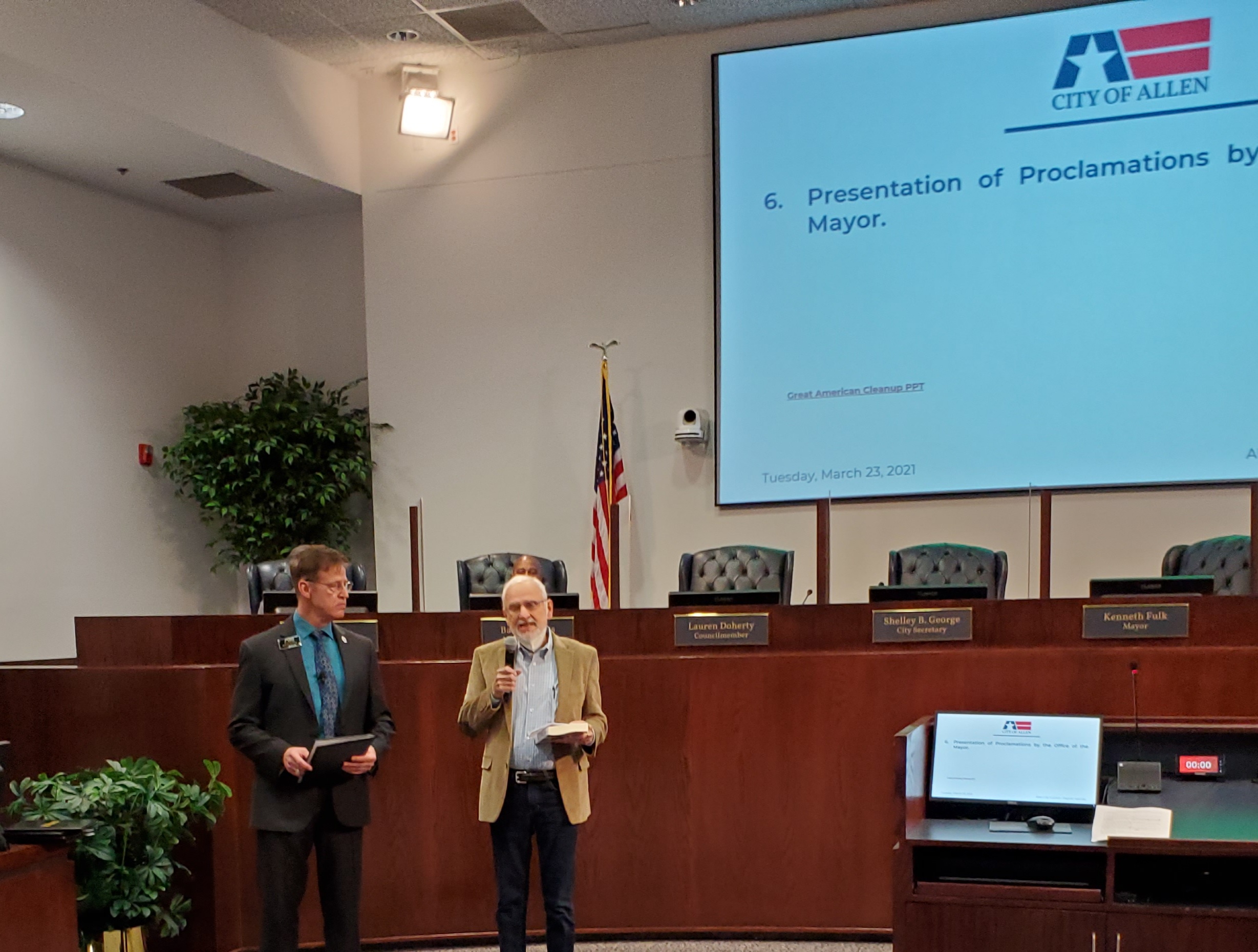
Mayor Ken Fulk read the proclamation at the March 23, 2021 City Council meeting.
Office of the Mayor
City of Allen
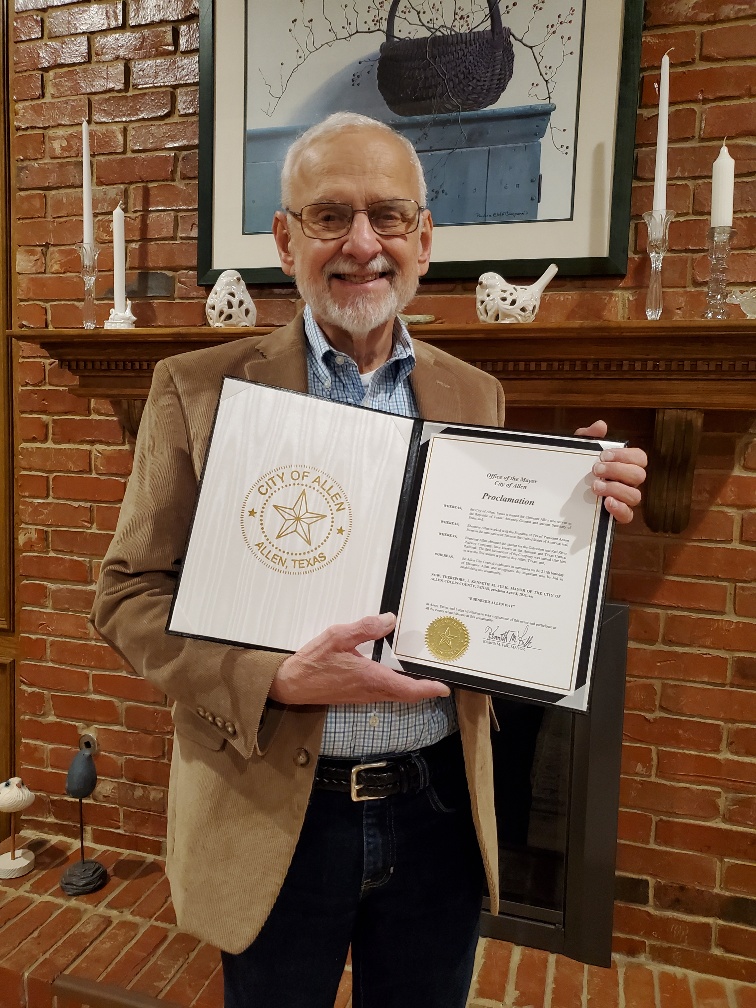
Proclamation
WHEREAS, The City of Allen, Texas is named for Ebenezer Allen, who served as the Republic of Texas Attorney General and interim Secretary of State; and
WHEREAS, Ebenezer Allen worked with the Republic of Texas’ President Anson Jones in the annexation of Texas to the United States of America; and
WHEREAS, Ebenezer Allen obtained the charter for the Galveston and Red River Railway Company, later known as the Houston and Texas Central Railroad. The first locomotive of the Company was named after him as was the first station at present-day Allen, Texas; and
WHEREAS, the Allen City Council celebrates its namesake on the 217th birthday of Ebenezer Allen and recognizes the important role he had in establishing our community.
NOW, THEREFORE, I, KENNETH M. FULK, MAYOR OF THE CITY OF ALLEN, COLLIN COUNTY, TEXAS, proclaim April 8, 2021, as:
“EBENEZER ALLEN DAY”
in Allen, Texas, and I urge all citizens to take cognizance of this event and participate in all the events related thereto in this community.
Kenneth M. Fulk, MAYOR
Office of the Mayor City of Allen Proclamation of Ebenezer Allen Day
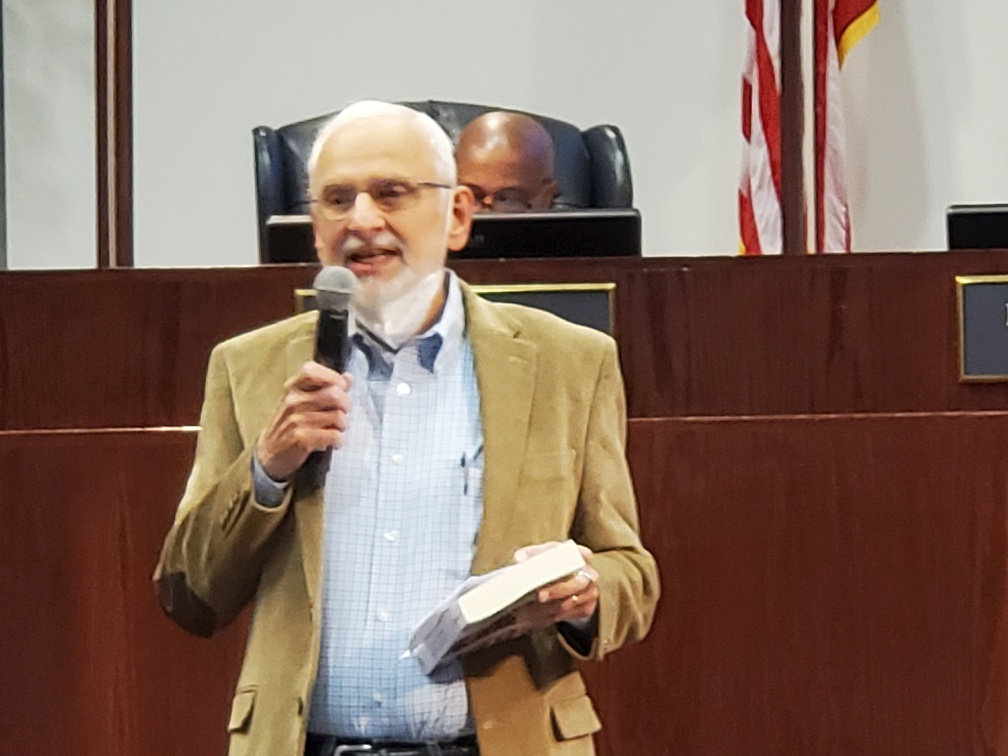
After Mayor Fulk read the proclamation, he invited me to say a few words about Mr. Allen’s life.
Mayor Ken Fulk and Allen Mesch
Allen Making Comments About Ebenezer Allen
After the meeting, I talked to representatives from the Heritage Guide of Allen about helping with any future events commemorating the day. They were interested in the idea and I am hopeful that the City of Allen may stage some activity to celebrate Ebenezer Allen’s birthday on April 8, 1804 in Newport, New Hampshire.
Allen with Proclamation
Allen presenting copy of Ebenezer Allen – Statesman, Entrepreneur, and Spy to Mayor Fulk
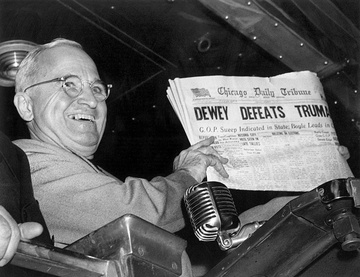
While writing another post, I was searching for a quote from President Harry S. Truman. I found several quotations that illustrate how he put the country before his prejudices and his political party.[1] Truman, who made civil rights a federal priority for the first time since Reconstruction, was a bigoted man who expressed strong racist sentiments before, during, and after his presidency.
National Archives and Records Administration. Office of Presidential Libraries. Harry S. Truman Library.
In 1911, Truman wrote to his future wife, Bess: ″I think one man is just as good as another so long as he’s honest and decent and not a n—r[2] or a Chinaman (Chinese). Uncle Will (Truman’s uncle) says that the Lord made a white man from dust, a n—r from mud, then He threw up what was left and it came down a Chinaman (Chinese).″
″(Uncle Will) does hate Chinese and Japs (Japanese),″ Truman continued. ″So do I. It is race prejudice, I guess. But I am strongly of the opinion Negroes ought to be in Africa, yellow men in Asia, and white men in Europe and America.″
In 1937, Senator Truman wrote a letter to his daughter describing waiters at The White House as ″an army of coons.″ In a letter to his wife in 1939, he described an event (possibly a Juneteenth celebration) as ″ n—r picnic day.″
Truman’s attitudes toward race were formed as a boy in Missouri. His grandparents owned slaves and his mother was imprisoned by Union troops during the Civil War and she remained ″violently unreconstructed″ for the rest of her life. Truman formed ″an abiding belief in white supremacy,″ Although Truman decreased his racist expressions after entering the White House, he continued to use racial slurs in private conversation for the rest of his life.
However, instead of governing under these principles, he acted in the “best interests” of the country. ″Whatever my inclinations as a native of Missouri might have been, as president I know this is bad. I shall fight to end evils like this.″
The president appointed a committee to study civil rights abuses and later supported the panel’s call for anti-lynching and anti-poll tax legislation. He also ordered the desegregation of the armed forces and became the first president to campaign in Harlem. As a result, he was denounced by his old Southern Democratic allies.
Some of Truman’s racist attitudes surfaced after he left the White House. He continued to use racial insults and opposed the 1960s sit-ins and said they might be Communist-inspired. He called Northerners who went on Freedom Rides meddlers and The Reverend Martin Luther King Jr. a troublemaker.
A 1947 report by the Truman administration titled To Secure These Rights presented a detailed ten-point agenda of civil rights reforms. In February 1948, the president submitted a civil rights program to Congress that proposed creating several federal offices dedicated to issues such as voting rights and fair employment practices. This caused a storm of criticism from southern Democrats in the runup to the national nominating convention, but Truman refused to compromise, saying: “My forebears were Confederates… but my very stomach turned over when I had learned that Negro soldiers, just back from overseas, were being dumped out of Army trucks in Mississippi and beaten.”
Tales of the abuse, violence, and persecution suffered by many African American veterans upon their return from World War II infuriated Truman. These abuses were a major factor in his decision to issue Executive Order 9981 in July 1948 that required equal opportunity in the armed forces.In the early 1950s after several years of planning, recommendations, and revisions between Truman, the Committee on Equality of Treatment and Opportunity, and the various branches of the military, the services became racially integrated.
″Whatever my inclinations as a native of Missouri might have been, as president I know this is bad,″ he said, ″I shall fight to end evils like this.″- President Harry Truman
Executive Order 9980 in 1948, made it illegal to discriminate against persons applying for civil service positions based on race. A third order issued in 1951, established the Committee on Government Contract Compliance (CGCC). This committee guaranteed defense contractors did not discriminate because of race.
When Truman signed Executive Order 9981 on July 26, 1948, he declared “there shall be equality of treatment and opportunity for all persons in the armed services without regard to race, color, religion or national origin.” That same day, he also signed an executive order to desegregate the federal workforce.
“The main difficulty with the South is they are living eighty years behind the times and the sooner they come out of it the better it will be for the country and themselves. I am not asking for social equality, because no such thing exists, but I am asking for equality of opportunity for all human beings, and, as long as I stay here, I am going to continue that fight.” – August 18, 1948
“As Americans, we believe that every man should be free to live his life as he wishes. He should be limited only by his responsibility to his fellow countrymen. If this freedom is to be more than a dream, each man must be guaranteed equality of opportunity. The only limit to an American’s achievement should be his ability, his industry, and his character.” In the speech, Truman emphasized: “When I say all Americans, I mean all Americans.”[3]
Truman’s comments on various matters illustrated his understanding of government, politics, and society. They also made great newspaper headlines and quotes.
On equality…
“When even one American – who has done nothing wrong – is forced by fear to shut his mind and close his mouth – then all Americans are in peril.”
“You know that being an American is more than a matter of where your parents came from. It is a belief that all men are created free and equal and that everyone deserves an even break.”
“I have no desire to crow over anybody or to see anybody eating crow, figuratively or otherwise. We should all get together and make a country in which everybody can eat turkey whenever he pleases.”
“The human-animal cannot be trusted for anything good except en masse. The combined thought and action of the whole people of any race, creed or nationality, will always point in the right direction.”
On politics…
“Republicans approve of the American farmer, but they are willing to help him go broke. They stand four-square for the American home—but not for housing. They are strong for labor—but they are stronger for restricting labor’s rights. They favor minimum wage—the smaller the minimum wage the better. They endorse educational opportunity for all—but they won’t spend money for teachers or for schools. They think modern medical care and hospitals are fine—for people who can afford them … They think American standard of living is a fine thing—so long as it doesn’t spread to all the people. And they admire the Government of the United States so much that they would like to buy it.” – October 13, 1948
“Whenever a fellow tells me he’s bipartisan, I know he’s going to vote against me.”
“Carry the battle to them. Don’t let them bring it to you. Put them on the defensive and don’t ever apologize for anything.”
On history…
“There is nothing new in the world except the history you do not know.”
“Men make history and not the other way around. In periods where there is no leadership, society stands still. Progress occurs when courageous, skillful leaders seize the opportunity to change things for the better.”
“Study men, not historians.”
“In reading the lives of great men, I found that the first victory they won was over themselves… self-discipline with all of them came first.”
“Most of the problems a President has to face have their roots in the past.”
“If you can’t stand the heat, get out of the kitchen.”
“Those who want the Government to regulate matters of the mind and spirit are like men who are so afraid of being murdered that they commit suicide to avoid assassination.”
“When you get to be President, there are all those things, the honors, the twenty-one-gun salutes, all those things. You have to remember it isn’t for you. It’s for the Presidency.”
“A President needs political understanding to run the government, but he may be elected without it.”
“A president either is constantly on top of events or, if he hesitates, events will soon be on top of him. I never felt that I could let up for a moment.”
“If I hadn’t been President of the United States, I probably would have ended up a piano player in a bawdy house.”
On America…
“America was not built on fear. America was built on courage, on imagination, and an unbeatable determination to do the job at hand.”
“It’s a recession when your neighbor loses his job; it’s a depression when you lose yours.”
“It is understanding that gives us an ability to have peace. When we understand the other fellow’s viewpoint, and he understands ours, then we can sit down and work out our differences.”
“I do not believe there is a problem in this country or the world today which could not be settled if approached through the teaching of the Sermon on the Mount.”
Ebenezer Allen was not the only New Englander to make his mark in Texas. The contributions and importance of these immigrants are immediately evident in the names of counties in the Lone Star State.
Of the 253 Texas counties, ten are named in honor of people who were born in New England:
Connecticut 1
Starr County – James Harper Starr (1809–1890), a treasurer for the Republic of Texas and Confederate official
Maine 2
Howard County – Volney Eskine Howard (1849–1853), U.S. Representative from Texas
Montague County – Daniel Montague (1844–1846), a state senator and early surveyor
Jones County – Anson Jones, the fifth president of the Republic of Texas (1844–1846)
Lynn County – William Lynn, a soldier in the Texas Revolution who is believed to have died defending the Alamo
Sherman County – Sidney Sherman (1805–1873), a soldier in the Texas Revolution
New Hampshire 2
Kendall County – George Wilkins Kendall, an early journalist and sheep rancher who gained national fame as a war correspondent during the Mexican American War
Cochran County – Robert E. Cochran (1810–1836), a defender of the Alamo
Vermont 1
Wheeler County – Royal Tyler Wheeler, the second Chief Justice of the Texas Supreme Court
I ask the question because for much of the past week (February 14 to February 20) some Texans have been without power, clean water, and natural gas. As we thaw out, we are confronted with broken pipes, water damage, and other problems.
What better time to forget your problems and settle into a comfortable chair with a eBook.
Teacher of Civil War Generals – Major General Charles Ferguson Smith, Soldier and West Point Commandant – Kindle Format
Your Affectionate Father, Charles F. Smith– Kindle Format
Charles A. Marvin – “One Year, Six Months, and Eleven Days”– Kindle Format
Preparing for Disunion – West Point Commandants and the Training of Civil War Leaders– Kindle Format
Ebenezer Allen – Statesman, Entrepreneur, and Spy– Kindle Format
I would be happy to add your eBook to the list with the link you want. There should be a common topic for the book listed. eg don’t include a children’s book on a site devoted to historical non-fiction. Perhaps you might try the same idea on your author webpage. I would be happy to receive your comments etc. on this idea.
The Professor and the Madman (Courtesy of Wikipedia)
The Professor and the Madman is a biographical film based on the book The Surgeon of Crowthorne or The Professor and the Madman by Simon Winchester.
The movie is about Professor James Murray (Mel Gibson), who became director of an Oxford University Press project in 1879, The New English Dictionary on Historical Principles (now known as the Oxford English Dictionary), and the man who became his friend and colleague, W. C. Minor (Sean Penn), a retired U. S. Army surgeon who submitted more than 10,000 entries while he was confined at Broadmoor Criminal Lunatic Asylum at Crowthorne, England.
William Chester Minor, a retired U. S. Army surgeon, suffered from the delusion that he was being pursued by a killer. During an episode in London, Minor killed an innocent stranger, George Merrett. He was tried in 1872, found not guilty because of insanity, and sent to Broadmoor Criminal Lunatic Asylum.
Doctor Brayne (Stephen Dillane) meets Minor at Broadmoor. Minor saves a guard’s life by amputating the man’s leg. Filled with guilt, Minor asks that most of his army pension be given to Eliza Merrett (Natalie Dormer), his victim’s widow. A prison guard, Muncie (Eddie Marsan), became an intermediary between Minor and Mrs. Merrett. Muncie delivers the offer Mrs. Merrett who refuses the pension. Brayne promises to protect him from his imagined pursuer, gives him room to paint, and allows him access to his library of rare books.
Broadmoor Criminal Lunatic Asylum (Courtesy of Wikipedia)
In Oxford, James Murray interviews for a position as editor of the Oxford English Dictionary. Murray was a self-taught scholar who left school at fourteen and had no degree. His application is criticized by some members of the Oxford University Press oversight committee is skeptical of Murray’s credentials, he is selected for the overwhelming task.
An oversight committee board member believes that “all words are valid in the language. Ancient or new, obsolete, or robust on, foreign-born or homegrown. The book must inventory every word, every nuance, every twist of etymology, and every possible illustrated citation from every English author. All of it or nothing at all.”
Murray has a solution to this intimidating assignment. He suggests that the project should enlist volunteers from everywhere English is spoken. He wrote an appeal to English-speaking people around the world and asked them to send their contributions on slips of paper. Booksellers, librarians, and newsagents distributed the request.
Muncie brings Christmas dinner to the Merretts. Finally, Eliza Merrett asks to see Minor and accepts his financial support. Minor says his life belongs to her.
Muncie and the guards give Minor a book that contains Murray’s appeal. Minor tells Brayne that he will be “all right” with this work and more books. Soon a volume of slips fills his room. Minor submits 1,000 slips to Murray and offers to take on the most elusive words, giving his address as “Crowthorne.” The slips are sent to Murray and the two men begin to correspond.
Murray makes an unexpected visit to Broadmoor. He carries a bundle of words for Minor, who Murray believes is a staff member. When Murray sees the manacles, he is not unsettled. “You are not alone—consanguineous”, he says. The word “consanguineous” means having the same lineage or origin or having a common ancestor. In this instance, I believe Murray uses the word to tell Minor that they kindred spirits and that Minor is not alone. Brayne encourages Murray’s visits.
The Professor and the Madman is an extraordinary tale of madness, genius, and the incredible obsessions of two remarkable men that led to the development of the Oxford English Dictionary.
The Professor and the Madman (Courtesy of Amazon.com)
The book was praised by the New York Times Magazine as “masterfully researched and eloquently written” and “the linguistic detective story of the decade.” the movie received poor reviews. On the review aggregator website Rotten Tomatoes, the film holds an approval rating of 43%, based 30 reviews, with an average rating of 5.50/10. On Metacritic, the film has a weighted average score of 25 out of 100, based on four critics, indicating “generally unfavorable reviews.” Nick Allen of RogerEbert.com gave the film 1½ out of 4 stars, calling it “the latest fiasco in bad movie history… the presence of Gibson and his co-star Sean Penn give the project a stuffy sanctimoniousness.”
See the movie or read the book to learn about the history of the dictionary